Column · 24 August 2026
6 lectures
Our churches are burning!
A historic wooden church in New Brunswick’s Acadian Peninsula burned to the ground in the early hours of August 24, 2026. The suspected arson at Saint-Simon is the latest in a series of church fires that have destroyed dozens of places of worship across Canada since 2021, erasing physical landmarks of community memory and faith.
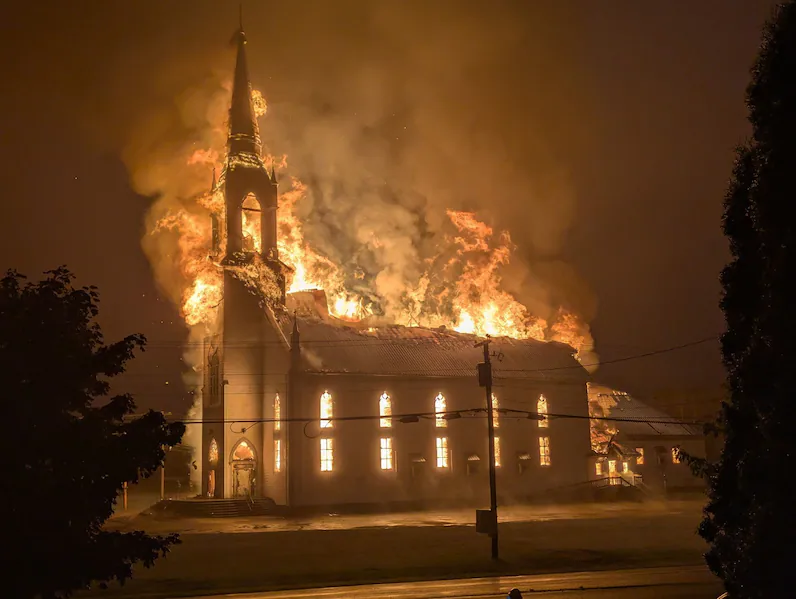
In the night of August 23 to 24, 2026, Saint-Simon Church, the largest wooden church in New Brunswick, was completely consumed by flames.
Located in the small village of Saint-Simon on the Acadian Peninsula (now part of Caraquet), this century-old church, built between 1910 and 1920 by Acadian architect Nazaire Dugas, is now nothing more than a pile of ashes and blackened beams. Around 3:20 a.m., motion detectors inside the building were triggered. Ten minutes later the fire alarm sounded. Firefighters from Caraquet, Bertrand and Shippagan fought the blaze for hours. They briefly believed they had it under control, but once the flames broke through to the roof and the attic, there was nothing left to do. The wood, the varnish, the pews — everything burned.
No one was injured. Four neighbouring buildings suffered heat damage. Caraquet Fire Chief Luc Dugas said early that morning the fire was suspicious. The RCMP and the Office of the Fire Marshal are investigating.
In front of the smoking remains, the Acadian, Canadian and New Brunswick flags still flew. Residents stood in silence, visibly moved. “The church was the main place for us… Now there will be no more funerals here, no more weddings, no more baptisms. It’s a huge loss for the parish and the community,” one resident said. Weddings, funerals, baptisms, basement meals, choirs — this building was not only a place of worship. It was the beating heart of the village.
Before the fire, the interior was simple and luminous: blue vaults, statues, an organ, wooden pews. Generations of Acadians had prayed, sung, mourned and celebrated there.
Today only smouldering ruins remain, charred beams, and on the ground a metal cross half-buried in the debris.
This is not an isolated case
Public data and journalistic investigations show a clear rise in church fires across Canada since 2021. A CBC News investigation published in January 2024 found that at least 33 churches were completely destroyed by fire between May 2021 and December 2023. Of these, 24 were confirmed arsons, two were accidental, and the rest remained under investigation at the time. Roughly half occurred on First Nations reserves or in small rural communities. Most cases remain unsolved; only nine led to arrests, and in the majority no clear motive was established.
A 2025 Macdonald-Laurier Institute report (an empirical analysis of Statistics Canada data) documented 238 arson attacks on religious institutions between 2021 and 2023 — more than double the baseline from 2011–2017. The rate of arsons targeting places of worship nearly doubled. The Prairies and British Columbia were hit hardest. Data for 2024 and 2025 remain incomplete, but the phenomenon has not stopped.
Here are documented examples reported by media over the past three years:
- June 2024 – St. Anne’s Anglican Church (Toronto, Ontario): Historic church completely destroyed. Initially not considered suspicious; the Ontario fire marshal later concluded in November 2025 that it was deliberately set (multiple points of origin).
- September 21, 2025 – All Saints Ukrainian Orthodox Church (Bellis, Alberta): Nearly century-old church reduced to ashes. Confirmed arson involving accelerant, part of a crime spree. Several suspects arrested.
- September 1, 2025 – Thunderchild First Nation church (Alberta): Burned after a break-in. Case remains unsolved.
- September 16, 2025 – Our Lady of the Snows (Colville Lake, Northwest Territories): Historic log church destroyed. Cause undetermined.
- July 17, 2025 – Église de l’Immaculée-Conception (Saint-Ours, Quebec): Destroyed after being struck by lightning during severe thunderstorms (confirmed by the municipality and firefighters).
- February–April 2026 – Several churches in Quebec: Saint-Paul (Montreal area, February), Saint-Mathieu (Montérégie) and Saint-Romain (April, a deconsecrated nearly century-old building whose steeple collapsed). Causes under investigation for some.
- August 24, 2026 – Saint-Simon Church (New Brunswick): Today’s fire, ruled suspicious.
Other fires (attempts, partial damage or deconsecrated buildings) have been reported locally, but no comprehensive official list exists for 2024–2026. Traditional media (CBC, Global News, regional papers, Radio-Canada) covered most major total-loss cases. Some analysts and organizations note a low clearance rate and sometimes limited coverage of rural or reserve cases, which fuels the sense that the phenomenon is under-documented nationally. Police and insurance data (e.g., Ecclesiastical Insurance) indicate that arson remains a significant cause of fires in places of worship.
These destructions — whether criminal, accidental or undetermined — represent a real loss of heritage. Buildings that hosted generations of weddings, baptisms, funerals and community gatherings are disappearing. In regions such as Acadia, the Prairies or the North, it is often the last physical place of collective memory that vanishes.
The flames at Saint-Simon belong to this longer series. They carried away more than wood: a place where people learned to say “we.” It is now up to each community to decide what it will do with these ashes.