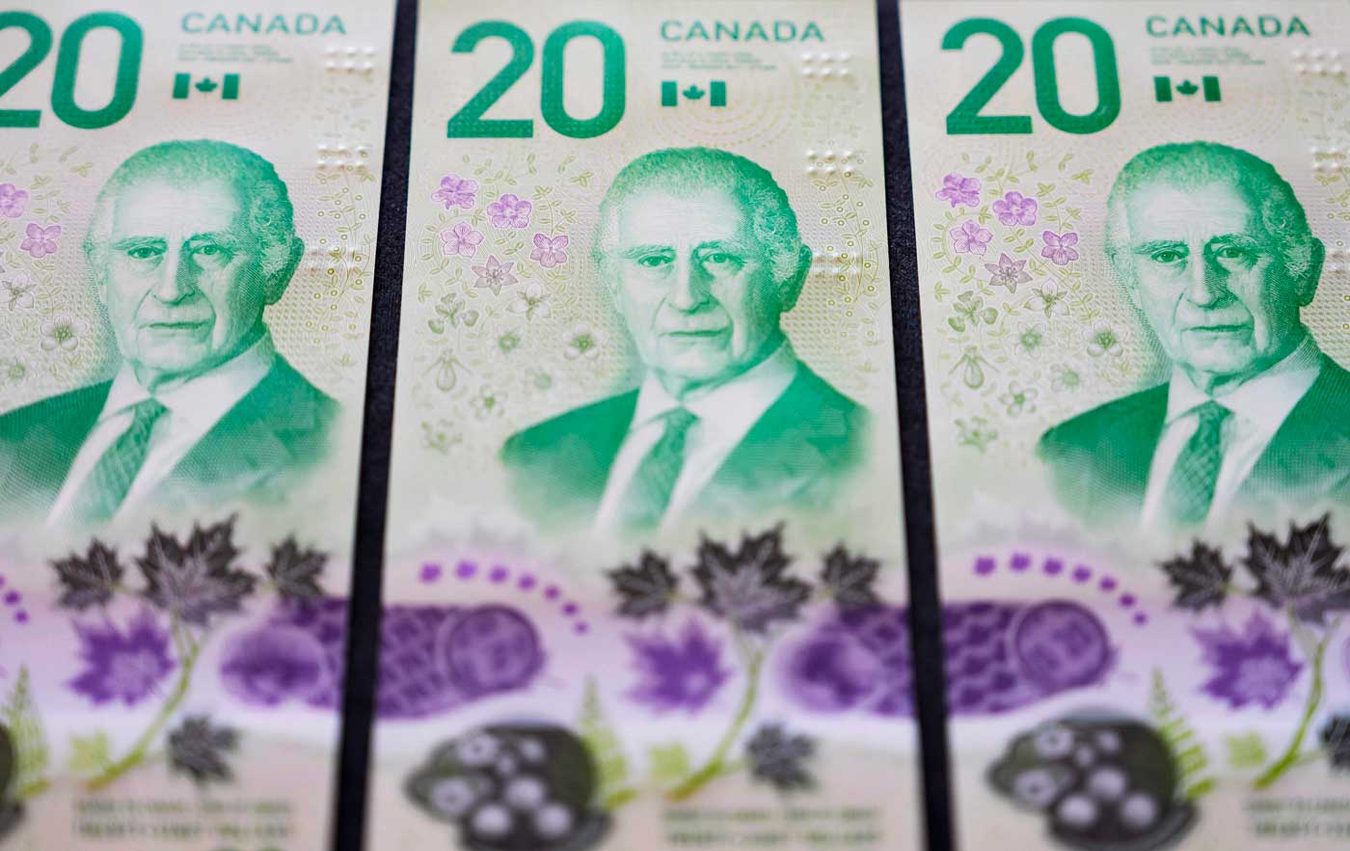
On September 3, 2026, in Ottawa, they unveiled the new twenty-dollar bill. Vertical. Green. Polymer. “More secure than ever.” At its centre: the face of King Charles III. On the back: the Vimy Memorial. Around him: the floral emblems of the provinces and territories, a few Indigenous plants in a window, a leafy tapestry to celebrate the monarch’s “environmental commitment.” It is scheduled to enter circulation in late February 2027.
They tell us this is history. They tell us this is “who we are.” They even tell us, through the voice of the Governor General, that our currency “affirms our sovereignty.”
Whose?
Not ours.
A face that is not ours
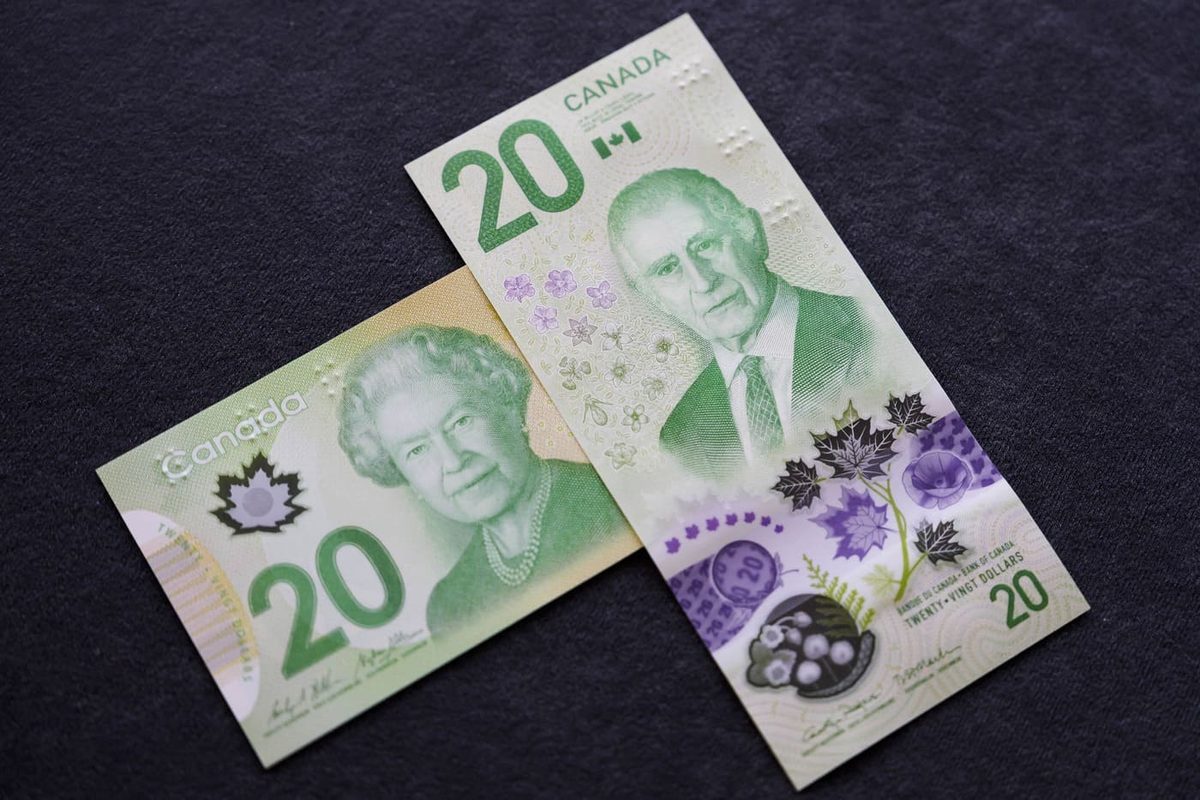
This is not a graphic detail. A banknote is a political act. It decides who is allowed to occupy the most ordinary space of all: the space of exchange. The bill you hand over at the corner store, fold into a wallet, give to a child. For more than seventy years, that face was Elizabeth II. Now it will be her son’s. The fourth British monarch to appear on a Canadian banknote. The first new one in more than seventy years. The first Canadian bill to bear Charles III.
English Canada calls this a constitutional tradition. In Quebec, it has another name: the memory of a conquest that never finished writing itself.
One may like gardens. One may respect a man. One may even find the design “nice.” That is not the question. The question is this: why, in 2026, should the Quebec people still handle, count, save, and pass on the effigy of a Crown to which they have never freely sworn allegiance?
Quebec has already settled the matter, at least in its own Parliament. Since December 2022, Members of the National Assembly no longer swear fidelity to the King. They swear loyalty to the people of Quebec. Period. That was the only reasonable thing to do. Ottawa, for its part, still requires federal legislators to swear an oath to Charles III. The new twenty-dollar bill is merely the pocket version of that demand: you do not have to say it out loud; you carry it in your pocket.
We did not choose this face. They put it in our hands.
Forced twice
In Ottawa they keep repeating that Quebecers are Canadians like any others. It is Confederation’s oldest lie.
We did not “choose Canada” the way one chooses a house. We were integrated. Twice.
First by arms, in 1759–1760, then by the Treaty of Paris in 1763. A French, Catholic, civil-law colony becomes a possession of the British Crown. They left us the language and the faith — not out of mystical generosity, but because a people one cannot simply erase still has to be governed.
Then by law, after crushing those who had dared to want a country. In 1837 and 1838, the Patriotes rise. They demand responsible government, respect for the French-speaking majority, an end to colonial arbitrary rule. They are already speaking of a nation. At Saint-Denis, they hold. At Saint-Charles, at Saint-Eustache, they are broken. Villages burned. Men hanged. Others deported as far as Australia. In 1838, Robert Nelson proclaims the independence of Lower Canada. London answers with the Durham Report and the Act of Union of 1840: merge the two Canadas in order to drown French in an English majority.
1867 is not the fulfillment of a Quebec dream. It is the third stitch. We are sewn into an arrangement designed elsewhere, in a language of state that is not ours, under a Crown that is not ours.
Forced twice. “Integrated” twice. And then they wonder why the word Canadian does not fit us like a glove.
Je me souviens
The motto is not a tourism slogan. Nor is it, contrary to what is too often taught outside this place, a mere “remembrance of New France.” It is a refusal of amnesia.
I remember those who gave their lives so that French would not be reduced to a kitchen dialect. I remember the arrow sashes, the assemblies of the Six Counties, Chénier in the church at Saint-Eustache. I remember that the Monday before May 25, here, is not Victoria Day: it is the National Patriotes’ Day.
I also remember what English Canada has too often made of French: a concession, a courtesy, a cost. Never an equal. They tolerate our language in the statutes and nibble it away in the facts. They take offense when Quebec gives itself the tools to endure, and find it perfectly natural that the face of the British sovereign should still occupy the most widely used banknote in the country.
There is a difference of nature, not merely of degree, between Quebec culture and that of English Canada. A language. A legal tradition. A memory that is both Catholic and secular. A literature, a theatre, a songbook, a way of inhabiting winter and politics. A relationship to the state that is not Toronto’s. A relationship to Empire that is not Ottawa’s. To deny that is already to begin dissolving us.
Official Canada has always been better at celebrating Vimy than Saint-Denis. Vimy is on the back of the new bill: a just monument to the dead of 1917, and a Canadian national story written without asking us whether we recognize it as our own. The Patriotes will never have their place on Ottawa’s currency. That is not an oversight. It is a choice.
Contempt does not need to shout
We are sometimes told: “Nobody despises you.” In Canada, contempt is rarely vulgar. It is administrative. It is statistical. It is constitutional.
It consists in speaking of “a province like the others” when naming the only founding people of North America that has no sovereign state. It consists in finding it excessive that we protect French, and normal that the King of England should appear on the money we earn in French. It consists in becoming emotional about “Canadian unity” every time Quebec recalls that it did not sign the Constitution of 1982.
The elites of Ottawa and of part of English Canada do not need to hate Quebec in order to reduce it. It is enough not to see it as a people. A people has a destiny. A province has a budget.
Quebec was meant to be a country. That is not an insult to the neighbours. It is the simplest sentence one can speak of a nation that already possesses everything that makes a state — territory, institutions, language, history, an intermittent but stubborn will — except formal sovereignty.
We will not swear the oath
Let it be carved somewhere other than Westminster:
Quebec will never, of its own free will, swear allegiance to the British Crown.
Our elected members, in Quebec City, no longer do so. It is little. It is already everything. The rest of the country may go on playing God Save the King; that does not oblige a nation to kneel.
The new twenty-dollar bill will circulate. We will use it, because bread still has to be paid for. But do not ask us to see “our” face in it. Ours is not at Buckingham. It is in the streets of Saint-Denis, in the archives of 1837, in the short sentence printed on licence plates and still not exhausted.

Je me souviens.
We do not have to apologize for existing. We do not have to thank a Crown for having survived. We do not have to recast as Canadian pride what was, for us, a series of defeats later baptized “compromises.”
One day, perhaps, another piece of paper — ours — will bear other faces. Until then, each time this new bill passes from hand to hand, let this much at least be remembered:
an empire does not own us merely because it prints its king on our money.
Quebec is not a province that has forgotten itself. It is a people that remembers.