Column · 8 September 2026
7 lectures
Saxony-Anhalt: a people that says stop
On 6 September 2026, Saxony-Anhalt handed the AfD 43.8% and cut the CDU down to 17%. Behind the score lies a decade of mass arrivals, rising violent crime, and sexual assaults that official statistics no longer allow anyone to treat as coincidence. Eastern Germany has voted to shut off the tap. Quebec should read the lesson before it becomes our own.

On 6 September 2026, the AfD won 43.8% in Saxony-Anhalt. The CDU collapsed to 17%. This is not a whim. It is the rejection of a migration policy that millions of Germans now consider unbearable.
The turning point was 2015. Angela Merkel opened the door to more than a million arrivals in a matter of months. Integration was promised. The opposite is what followed.
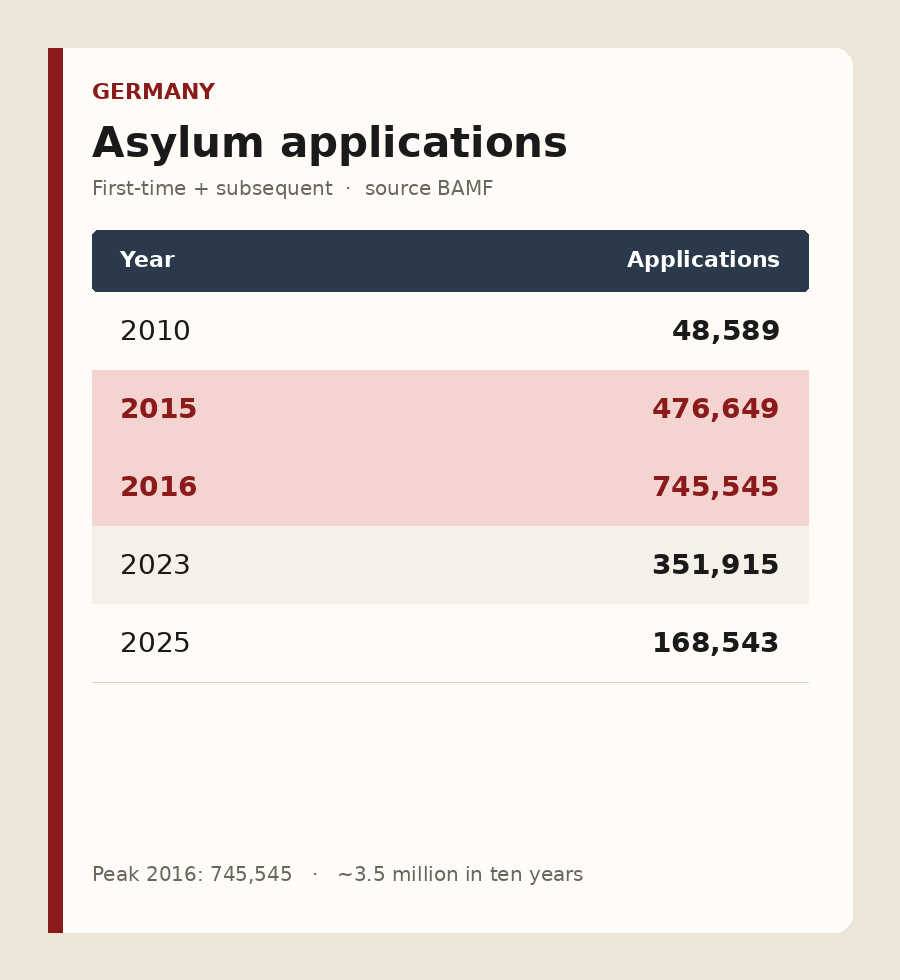
In ten years: about 3.5 million people “seeking protection.” Foreign nationals = ~15% of the population. Non-German suspects = 35 to 43%, depending on the offence.
New Year’s Eve, 31 December 2015. Outside the station and the cathedral, groups of men — the large majority North African, Arab, Muslim — surrounded, groped, robbed and assaulted women.
Official toll: - more than 1,200 complaints across Germany - ~650 women assaulted in Cologne - more than 400 in Hamburg - identified suspects in Cologne: mainly Algerians and Moroccans; many asylum seekers; a share already illegally present
The BKA acknowledged the link to the mass arrivals of 2015. Convictions were derisory given the scale of the events.
Then the incidents did not stop. They changed form.
- Solingen, August 2024 — Three dead at a festival. Perpetrator: a rejected Syrian, who should have been returned to Bulgaria. Attack claimed by Islamic State.
- Mannheim, May 2024 — An Afghan stabs people at a rally and kills police officer Rouven Laur. Sentenced to life, Islamist act.
- Würzburg, 2021 — A Somali in irregular status kills three people in the street.
These are not anecdotes. This is the visible cost of a tap left open.
Violence, in numbers
Violent crime cases (BKA / PKS: homicide, serious assault, serious rape, robbery with violence):
Share of foreign suspects in this violence: 33.2% in 2015 → 43.1% in 2024 → 42.9% in 2025.
Number of foreign suspects: 55,110 in 2015 → 85,012 in 2024 (+54%). German suspects, by contrast, have stagnated.
Suspects in 2024, excluding residence-status offences alone: Syria 64,780 · Afghanistan 31,443 · Iraq 18,941 · Morocco 10,472 · Algeria 9,115. North Africans account for ~9% of “migrant” suspects for ~0.5% of those granted protection.
Sexual assaults
The BKA does not classify rapes as “Islamist.” It classifies by nationality. After 2015, the countries that dominate these tables are Muslim-majority countries.
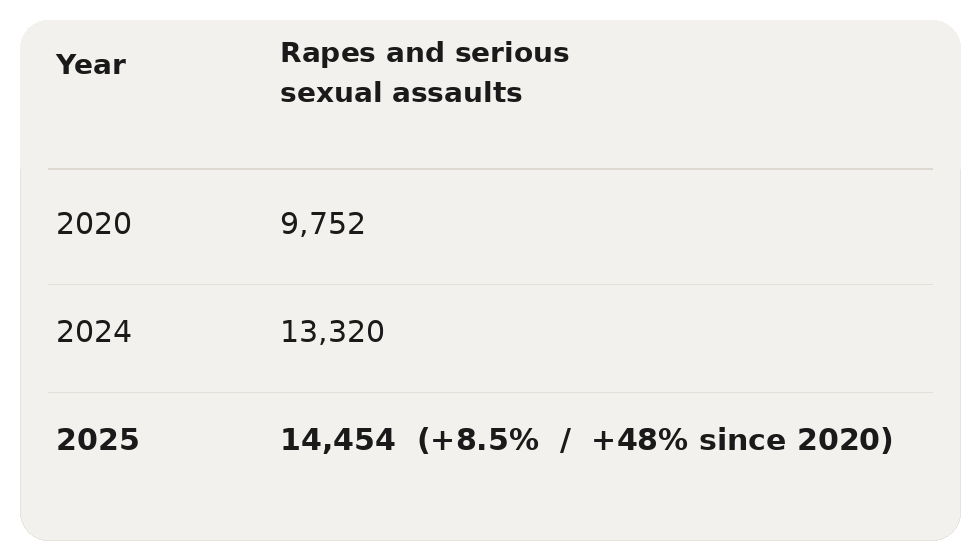
| Year | Rapes and serious sexual assaults | |-----:|----------------------------------:| | 2020 | 9,752 | | 2024 | 13,320 | | 2025 | 14,454 (+8.5% / +48% since 2020) |
Since 2018: about +70%. In 2024: 11,329 suspects, of whom 4,437 foreigners (39.2%) — for 15% of the population.
Gang rapes, 2024: 788 cases. Suspects: Germans 497 · Syrians 116 · Afghans 52 · Iraqis 40 · Turks 30. 51% of suspects did not hold a German passport.
In 2023: 8,800 sexual offences with at least one “migrant” suspect (+16.5% in one year, +52% vs 2019). Top nationalities: Syria, Afghanistan, Iraq.
The eastern voter did not vote “against humanity.” He voted against impunity, against deportations that never happen, against a state that protects the rejected claimant better than the victim.
What the AfD pledges to do, immediately, in Saxony-Anhalt:
- deportations from day one
- more detention places
- mandatory work for asylum seekers
- separate classes for children whose stay is precarious
- cutting subsidies to the reception industry
- reclaiming schools and public space (national flag, end of identitarian activism)
At the federal level: held borders, an end to asylum as a settlement pipeline, benefits in kind rather than cash, mass returns.
It does not have an absolute majority (39 seats out of 83). The other parties still refuse to govern with it. The message has already landed: the firewall protects the parties, not the streets.
And Quebec? Same lesson. A linguistic minority nation cannot indefinitely import populations it did not choose, on whom it does not impose its language, its laws, its rites and its mores. Volume, origin, pace, and the removal of rejected claimants are not technical details. They are the condition of French continuity here.
As a Québécoise woman, I do not treat this as a distant European file: everything that happens in Europe ends up happening here. I see what it would do to my streets and to my freedom to walk alone after midnight. An ideology that ranks the woman behind the man, the veil, and non-consent behind “shame” is not a cultural enrichment: it is a regression. Importing it in bulk, with no demands and no removal of those who are rejected, is not openness. It is accepting that we, women and girls, pay the price of a political taboo.
Quebec does not have Germany’s 2015 volumes. It has the duty: choose who enters, impose equality, secularism and French, and send back those who trample them.
My safety is not a detail to be negotiated. It is the first right.
Eastern Germany has just reminded us that a people still has the right to shut off the tap. Quebec does too — if it has the courage.