Founder
A man or woman who arrived under the French regime and left children here. A few thousand, no more.

Since 1608
A people is not an administration, nor a hotel, nor a slogan. It is a chain of births. A few thousand French people made Quebec. Their children are still here. It can be told simply.
In thirty seconds
Three thousand settlers. Eight hundred mothers. Four centuries. Millions of children.
3 200
inhabitants in 1663
~800
Filles du Roy
91 %
of the gene pool of French origin
6 M+
descendants today
Figures from the PRDH (Université de Montréal), BALSAC (UQAC) and the work of Vézina, Tremblay and Landry. This is not myth. It is the parish register, read to the end.
Four words, to start
A man or woman who arrived under the French regime and left children here. A few thousand, no more.
A young woman sent by Louis XIV, with a dowry, to found a household. About 800, between 1663 and 1673.
When a small group reproduces in place, with few newcomers, its traits — names, faces, sometimes diseases — spread.
The king’s regiment, 1,200 soldiers in 1665. Nearly 400 stay, marry, become fathers.
How it works
Picture a village of three thousand people. Almost no one else arrives. The children stay. The grandchildren stay. After ten generations the “village” numbers millions — and everyone is a little bit cousin.
1
Under the French regime, about 10,000 immigrants. Only a fraction — a few thousand — leave descendants. Those are the founders.
2
Families of eight, ten, twelve. Almost no newcomers after 1680. The village grows from itself.
3
Genes, names, faces repeat. 91% of the French-Canadian gene pool comes from those French founders. That is not an opinion. It is genealogy.
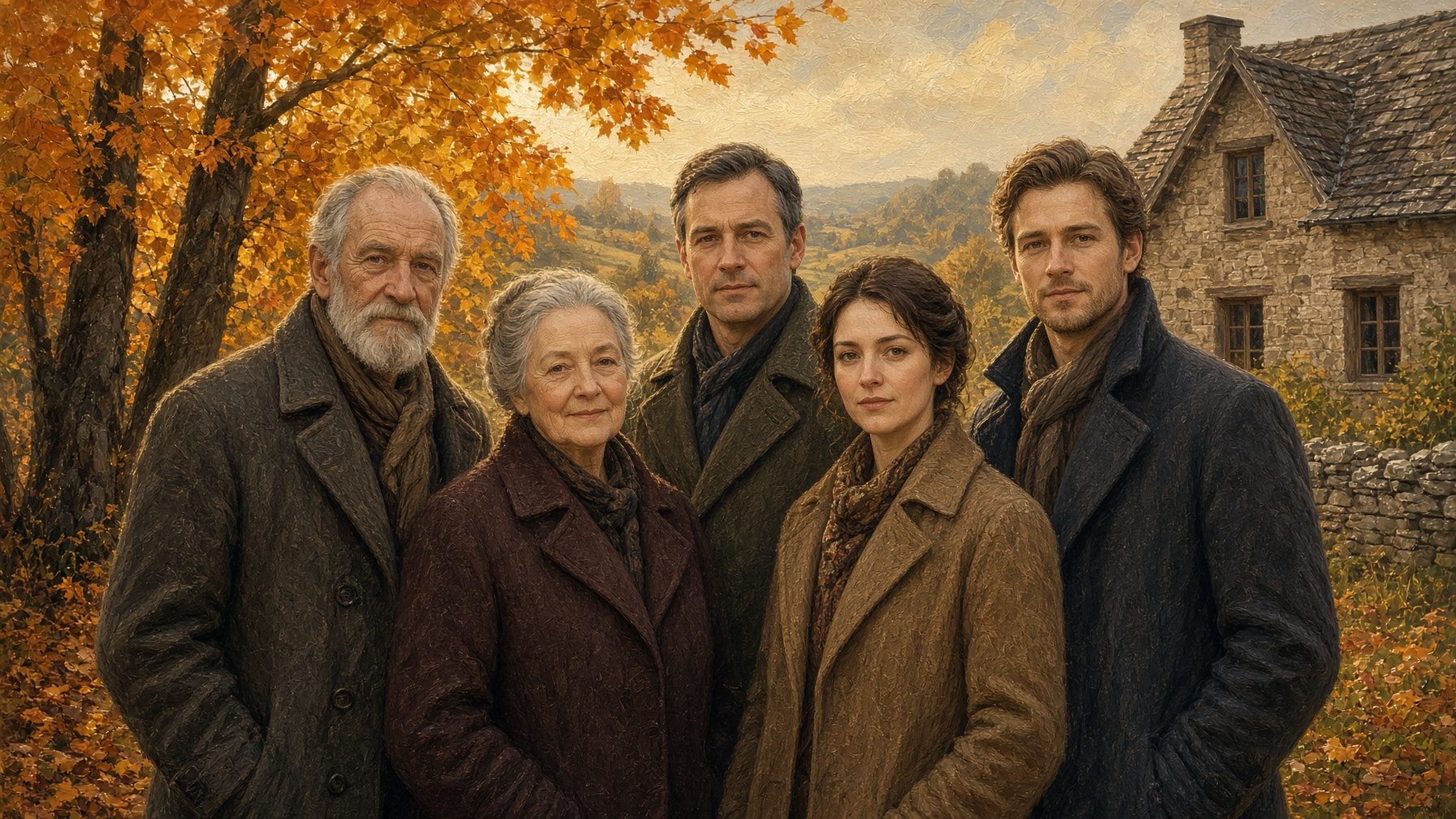
A lineage is not a theory. It is grandparents, parents, children, on the same land.
The diagram that counts
Here is the idea, in one picture. A large family, almost no immigrants after 1680, and the counter runs away. The bars are an order of magnitude — not a census. It is enough to see why one man from Perche could people a country.
Eight, ten, twelve children. Four or five who marry. Repeat ten times. You do not import a people. You give birth to one.
The counter
You do not “fill” a country by importing the world. You do it by being born here. Here is the curve, in six stops.
1608
28
Men at the Habitation
1663
3 200
Before the Filles du Roy
1681
9 700
Colony census
1760
70 000
At the Conquest
1851
890 000
Canada East
aujourd’hui
6 M+
Descendants in America
The problem, then the solution
In 1663 the colony is a camp of men. Without women, no households. Without households, no people. Louis XIV sends the Filles du Roy. In under twenty years the ratio balances — and the colony triples.
1663
About 2 men for every woman
3,200 souls. Indentured men, soldiers, too few wives. A trading post, not yet a country.
1681
Almost as many women as men
9,700 souls. The Filles du Roy are married. The cradles are full. The people begins.
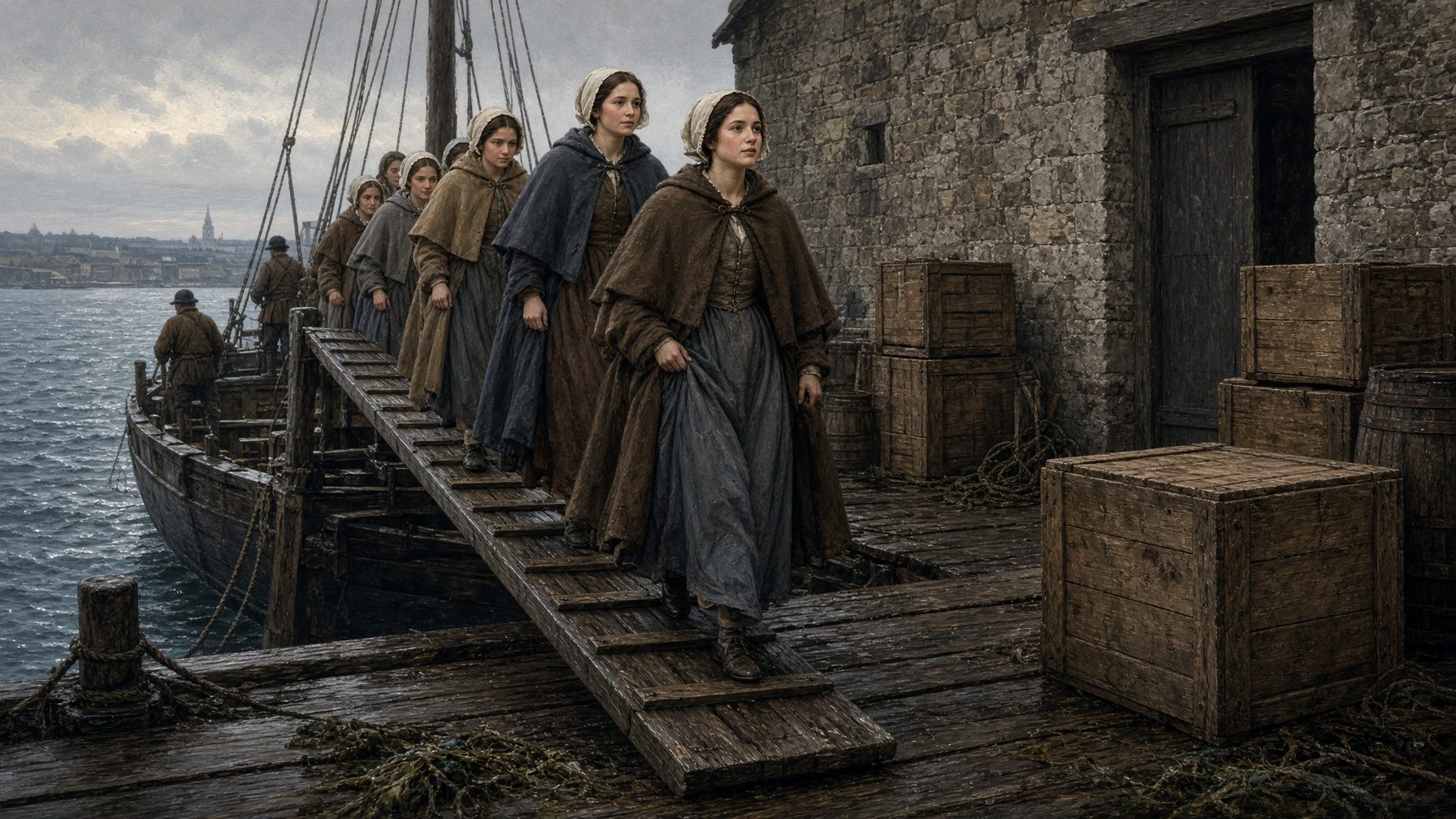
1663 – 1673
In 1663 the colony numbers 3,200 souls and too few women. Louis XIV pays the passage. They are called the Filles du Roy: young women, often orphans, sometimes widows, to whom the king offers a dowry to found a household in Canada.
Yves Landry counts 764 of them. Nearly 800, in round numbers. Half of all women who immigrated under the French regime. Marriage within five months, on average. More than 4,400 births attributed to them.
Today, two-thirds of the five million people in the BALSAC file descend from at least one Fille du Roy. Their genetic contribution to Quebecers born around 1960: 9.3% — some 40% of everything the French foundresses left.
What they brought
This was not a gilded legend. It was a contract. The king pays the passage and a dowry of about fifty livres. They land, they choose, they marry. Within five months, on average.
50 ₶
Money to found the household. Not charity: an investment in a people.
5 mo.
They do not come to “try their luck”. They come to have children, at once.
½
Half the women who arrived under the French regime. The rest of the picture is them.
4,400+
The first demographic shock. After that, the country makes itself.
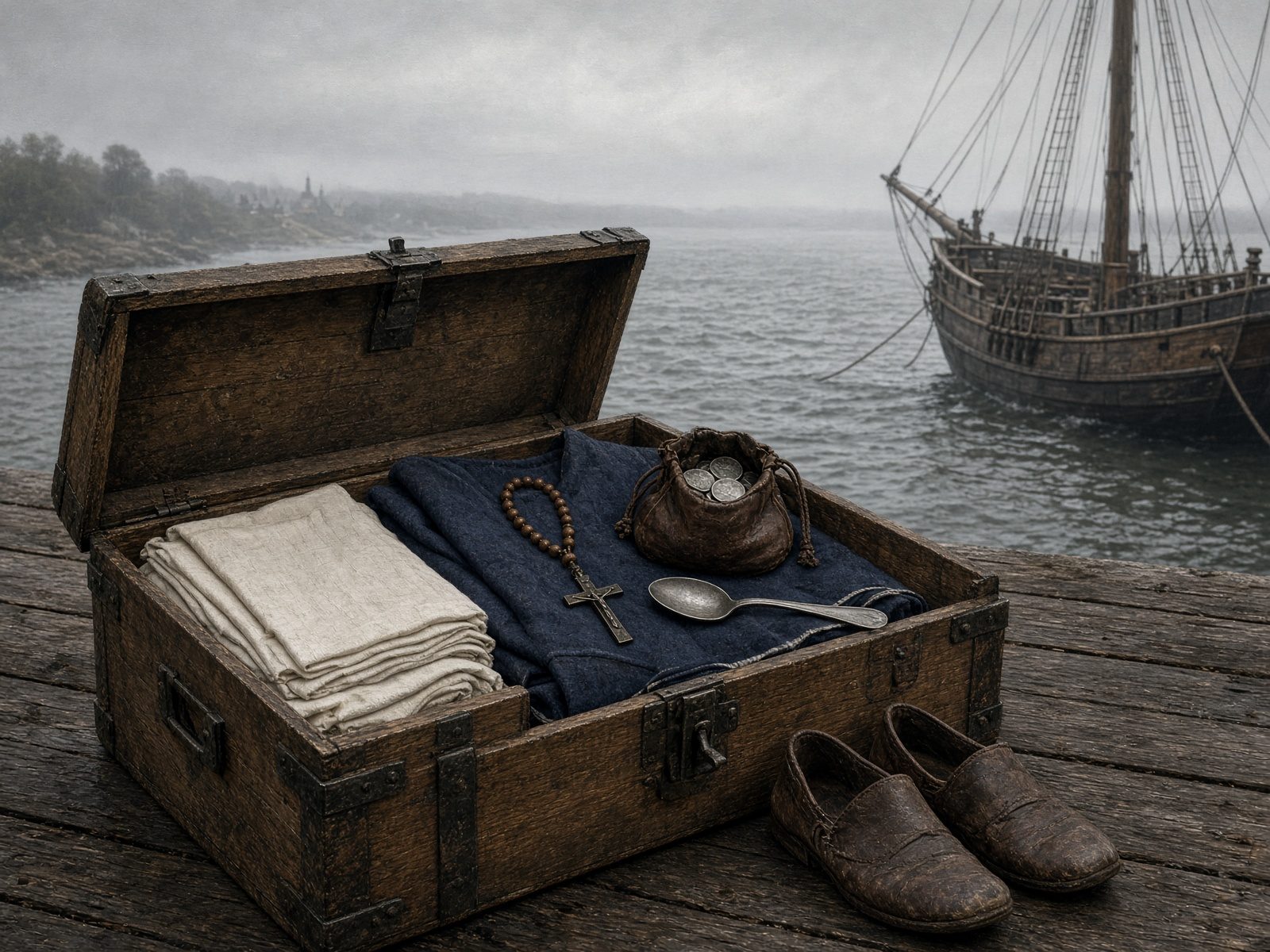
Linen, a wool dress, a rosary, a few coins. The makings of a household, not an empire.
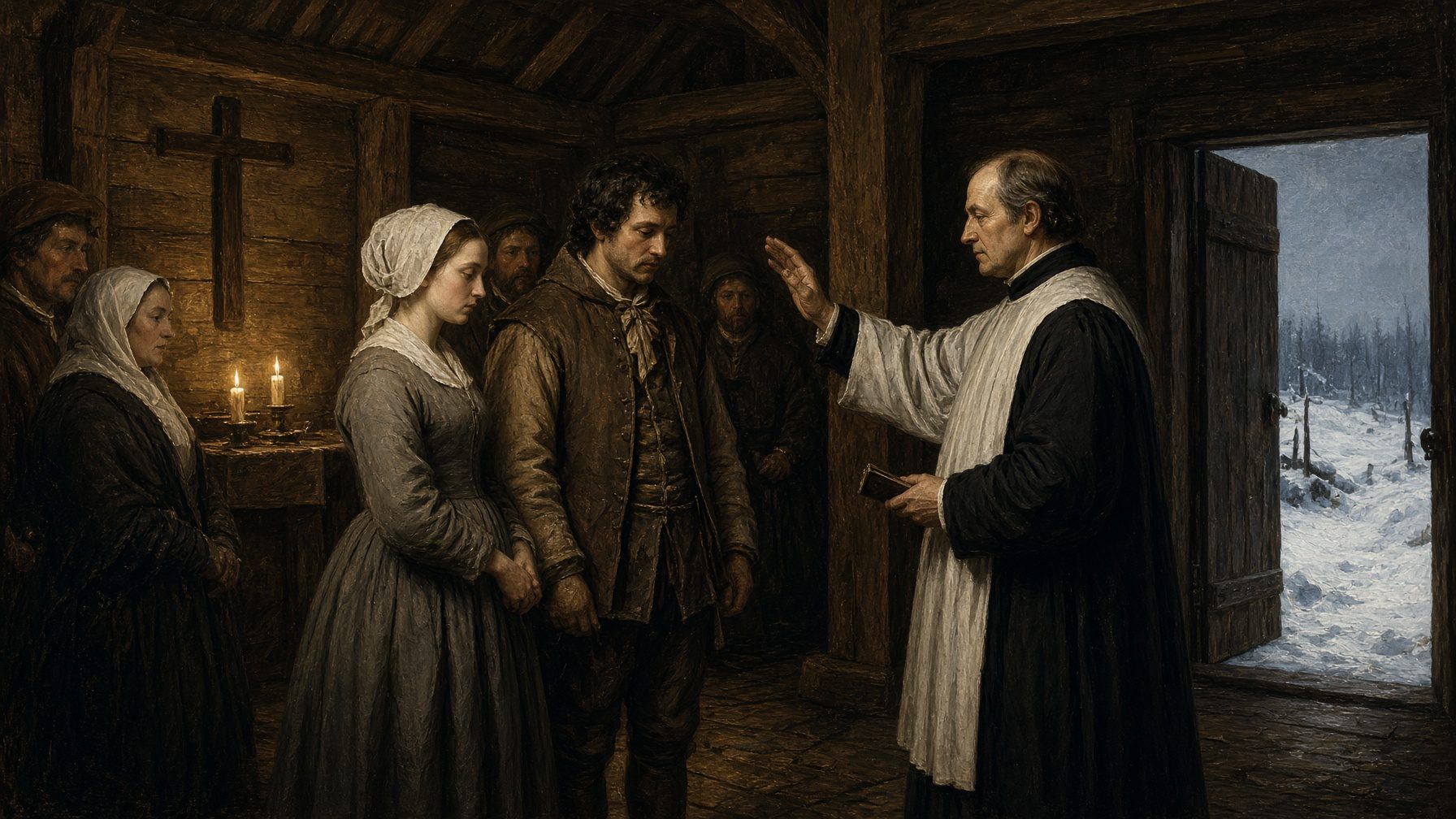
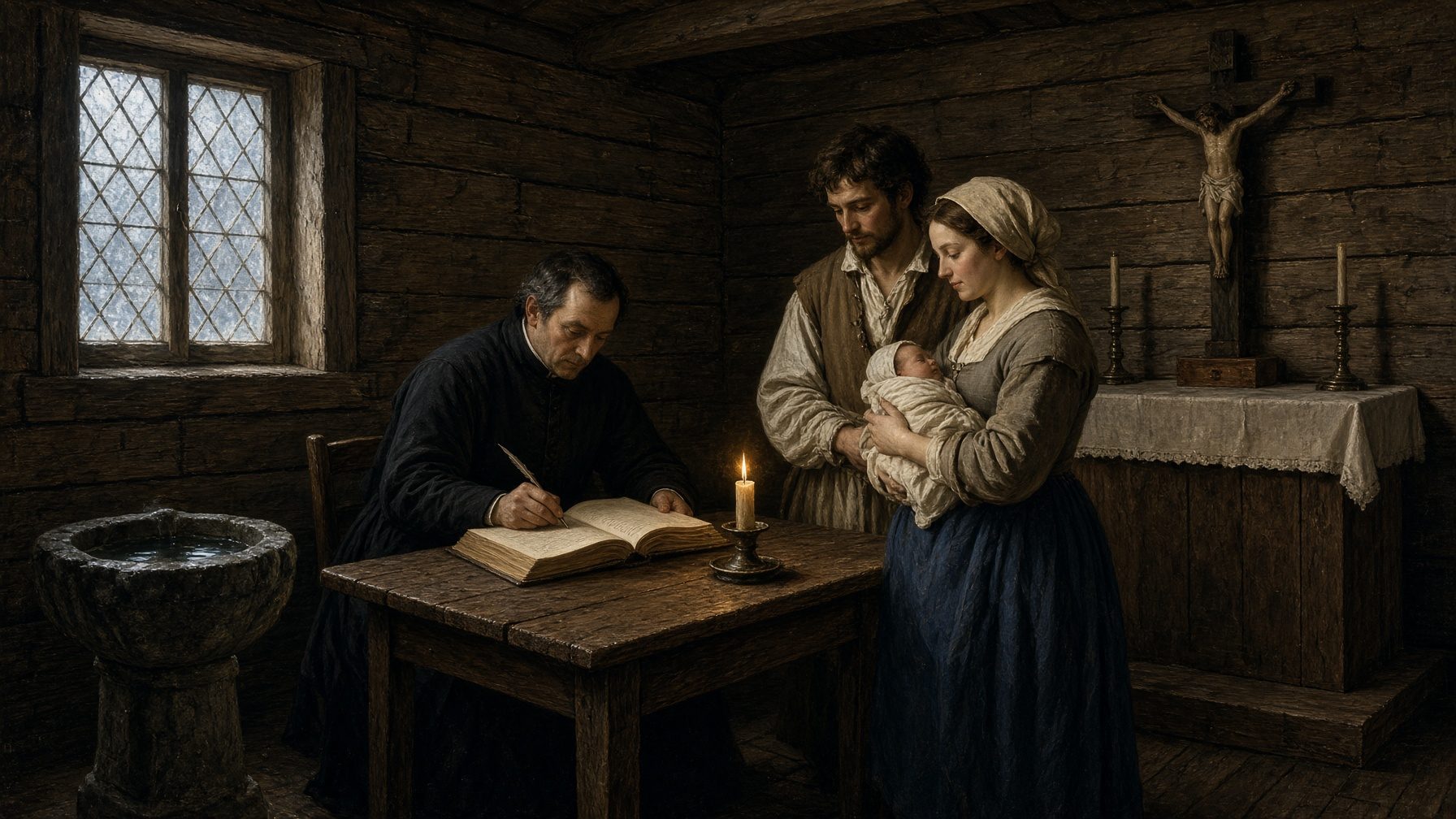
A wooden chapel, a soldier become habitant, a mass. That is how a people begins.
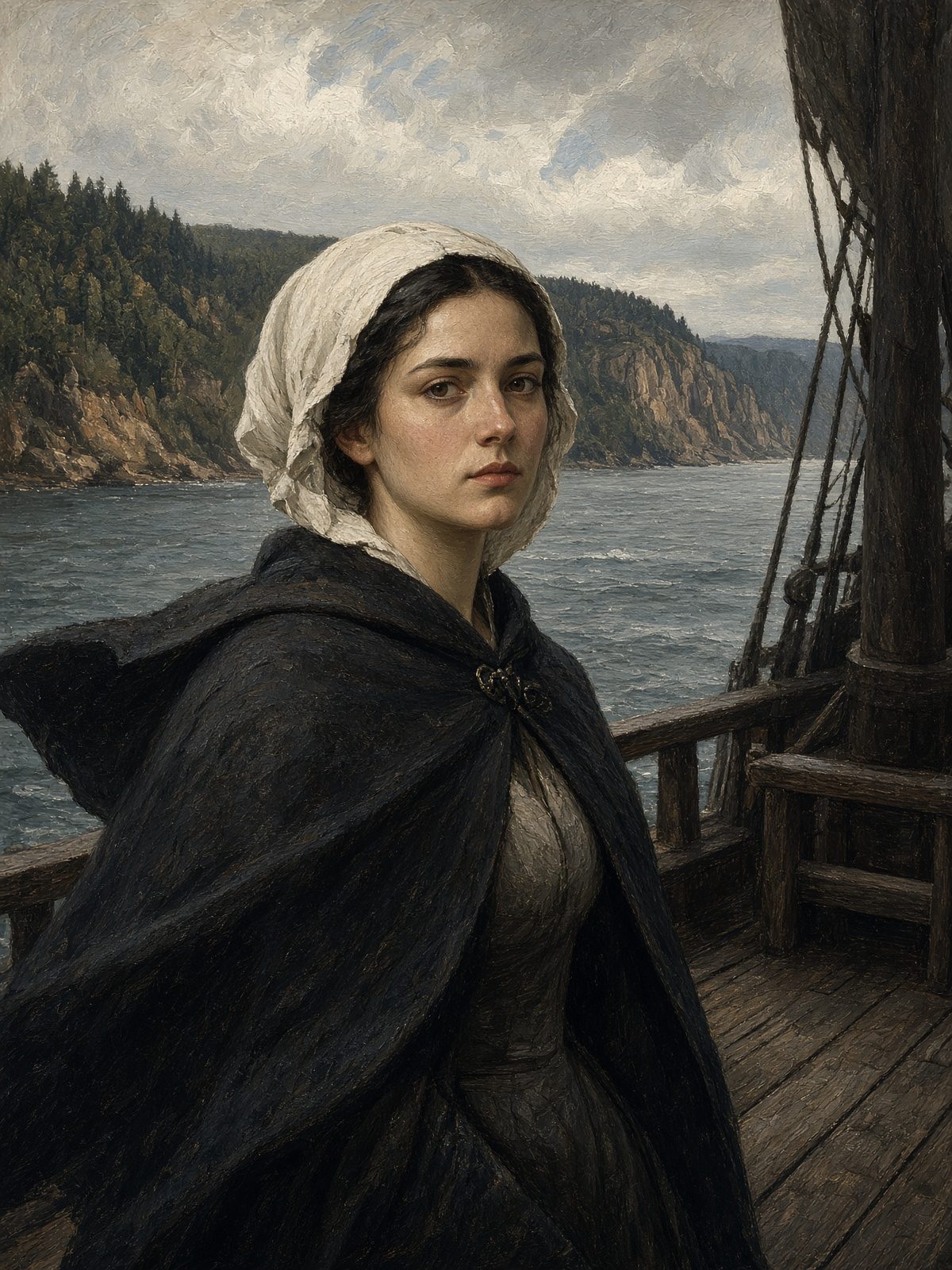
Where they came from
The men — indentured workers, Carignan soldiers, habitants — come mostly from the Atlantic: Normandy, Aunis, Poitou, Perche. The Filles du Roy often come from the Paris region. Two Frances, one people on arrival.
The fathers
Normandy, Perche, Poitou, Aunis
Western France. Ploughmen, soldiers.
The mothers
Île-de-France, Orléanais, Beauce
Often the city. Paris, and the king’s hospitals.
Origins of the Filles du Roy according to Landry (2013). Total: 774 recorded origins.
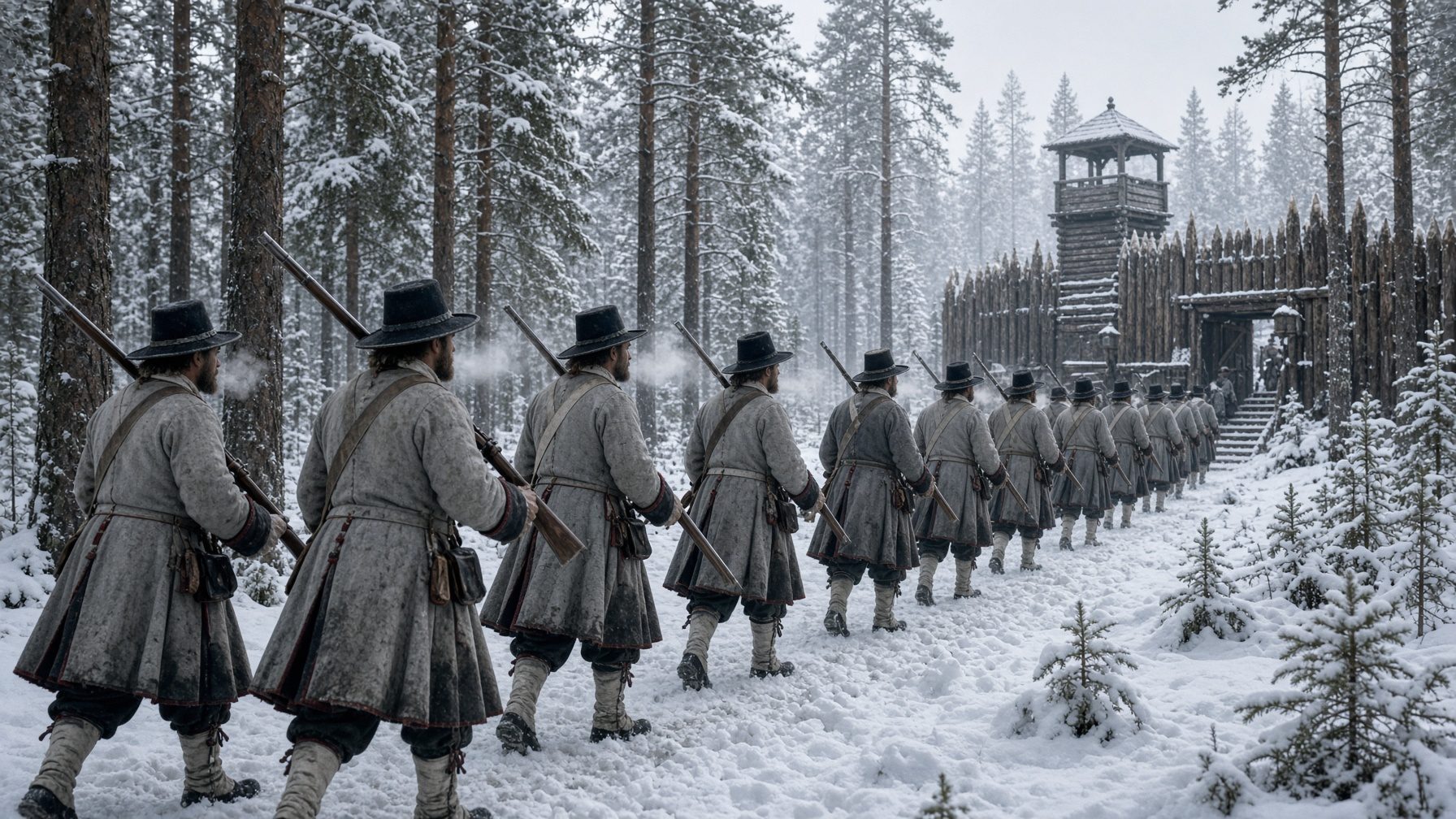
1665
The king sends a regiment. 1,200 soldiers. They come to make war, and many stay to make children. Nearly 400 settle. They are often the ones who marry the Filles du Roy.
Without those two waves — the arms, then the mothers — the colony remains a trading post. With them, it becomes a people. A people that will still speak French four centuries later, on the same shore.
~400soldiers who stay
~800Filles du Roy
a peoplethat never left the shore
The names we still carry
Tremblay, Gagnon, Roy, Côté. These are not “Quebec names” by chance. They are 17th-century hearths that swarmed. A single couple from Perche could leave tens of thousands of bearers.
Pierre Tremblay, from Perche (1647). The most common name in Quebec.
Three brothers from Perche. A name of land-clearers.
Several hearths, including Anne Lemaître — more than a million recorded descendants.
The shore of the St. Lawrence. A river-bank name.
Anjou and Perche. Ploughmen who became a people.
Western France. A name of habitants.
Normandy. One of the great 17th-century hearths.
A name of the road, become a name of a nation.
Perche again. The same source, another branch.
From Perche as well. Neighbours from home married neighbours.
Old-regime trades, transplanted here.
Perche. Again. The home village is still readable in the phone book.
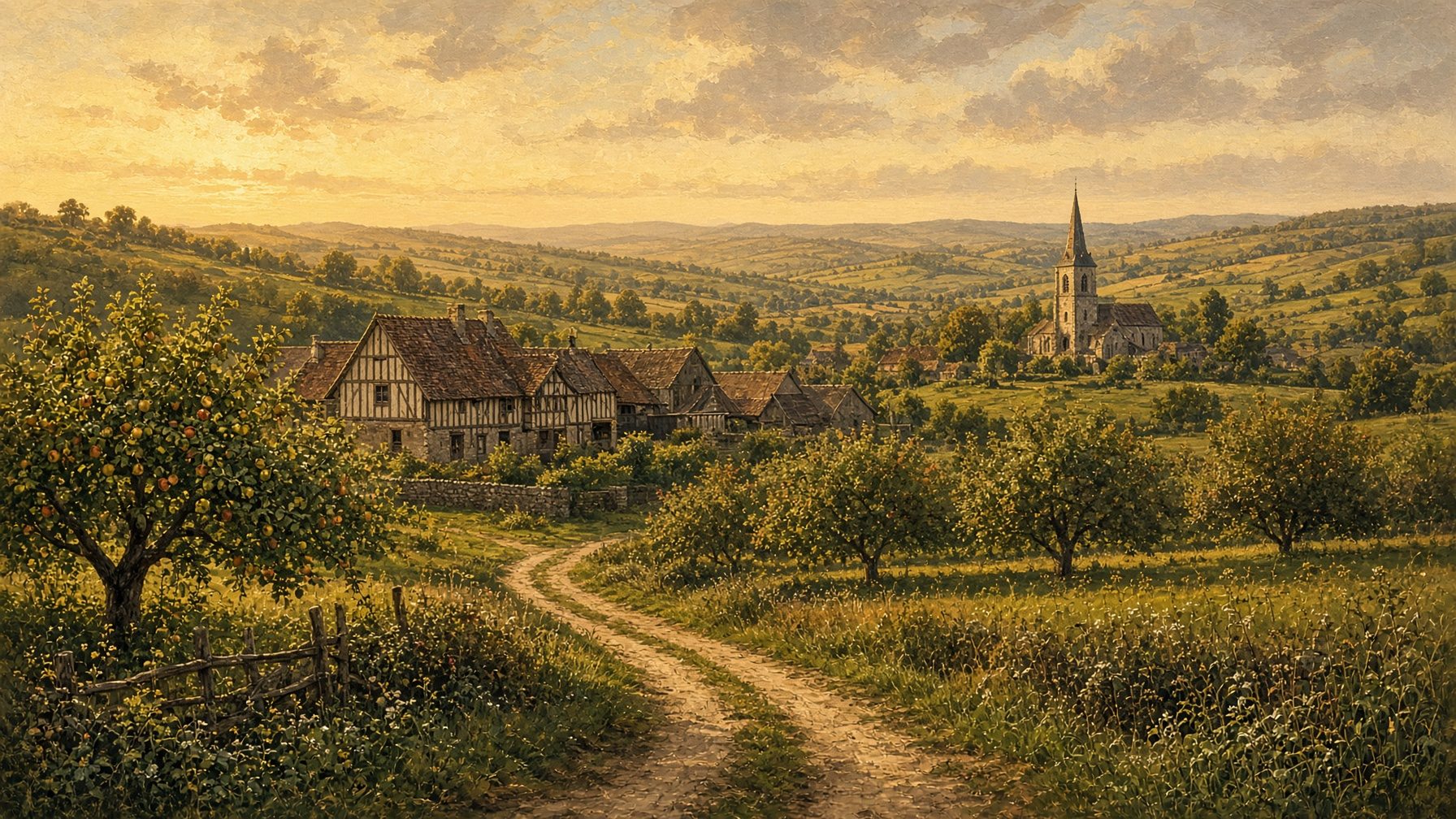
Perche, Normandy, Aunis: western France. That is where the fathers leave from. Their villages are still readable in our names.
From 1668 to you
We think the 17th century is far away. It is not. Your great-great-grandmother knew someone who knew a Fille du Roy. Four stops are enough to hold the thread.
1668
A Fille du Roy is married
1760
Her great-grandchildren see the Conquest
1960
The baby boom. The same names, in town.
2026
You. Twelve to fourteen generations.
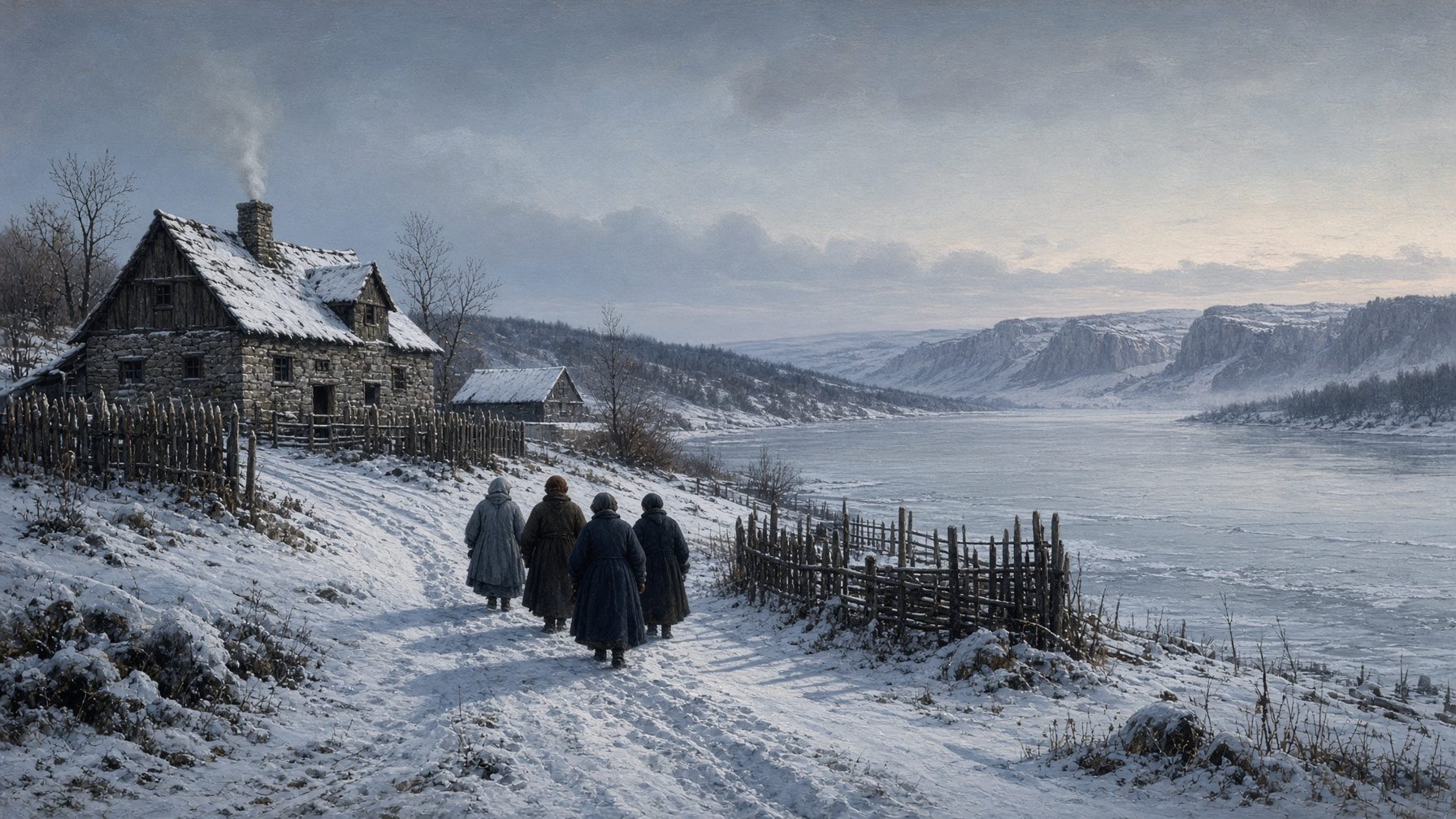
Winter, the shore, mass, the walk home. It is in that repetition that a people holds.
Why we know
Every baptism, every marriage, every burial. Quebec has one of the most complete parish registers in the world. The PRDH reconstructed the families. BALSAC followed the descendants. You do not invent a lineage. You read it.
That is why the figures hold: 764 Filles du Roy, 91% of the gene pool, two-thirds of the BALSAC file. Not a slogan. A count.
What it means
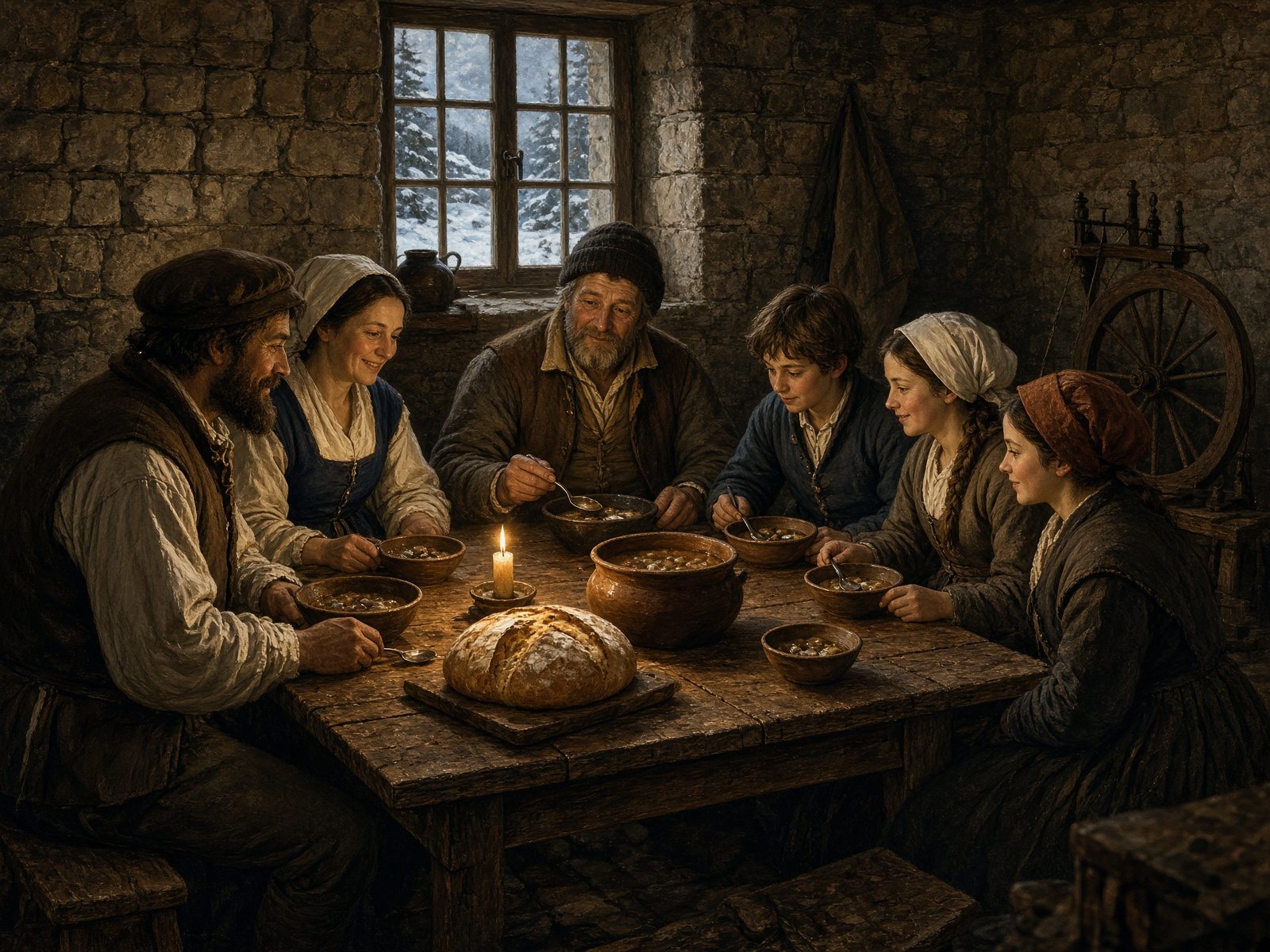
We are told Quebec is a land of immigration, like any other. That is false. Quebec is a land of foundation. A handful of French families held the winter, had children, handed down a language, a law, a table.
Two old-stock Quebecers often share a 17th-century ancestor. That is not a drawing-room curiosity. It is the definition of a people: we recognise each other, we owe each other something, we are not interchangeable.
A people that forgets its lineage agrees to be replaced. A people that names it knows what it has to hand down — and to whom it has the right to say no.
The signature
When a small group reproduces in place, two things happen. The founders’ genes fill almost the whole picture. And a few rare diseases, carried by one ancestor, become more common here than elsewhere. That is not a shame. It is a proof.
91 %
Share of the French-Canadian gene pool of French origin (Vézina, Tremblay).
More common in Saguenay–Lac-Saint-Jean. One founder, thousands of carriers.
Born here. It is named after our shores, not after a laboratory.
Two old-stock Quebecers: often a shared 17th-century ancestor. The village did not move.
The thread of time
1608
Champlain founds Quebec. A palisade, a few dozen men.
1634
Robert Giffard brings families from Perche. Real settlement begins.
1663
3,200 souls. Too many men, too few women. Louis XIV decides.
1665
The Carignan-Salières regiment: 1,200 soldiers. Nearly 400 stay and marry.
1663–1673
The Filles du Roy. About 770 to 800 women, the king’s dowry, married within months.
1681
The colony has almost tripled. The sex ratio is restored.
1760
70,000 Canadiens. Conquest changes the flag, not the blood.
aujourd’hui
Millions of descendants. The same names. The same shore.
An appeal to French Canadians
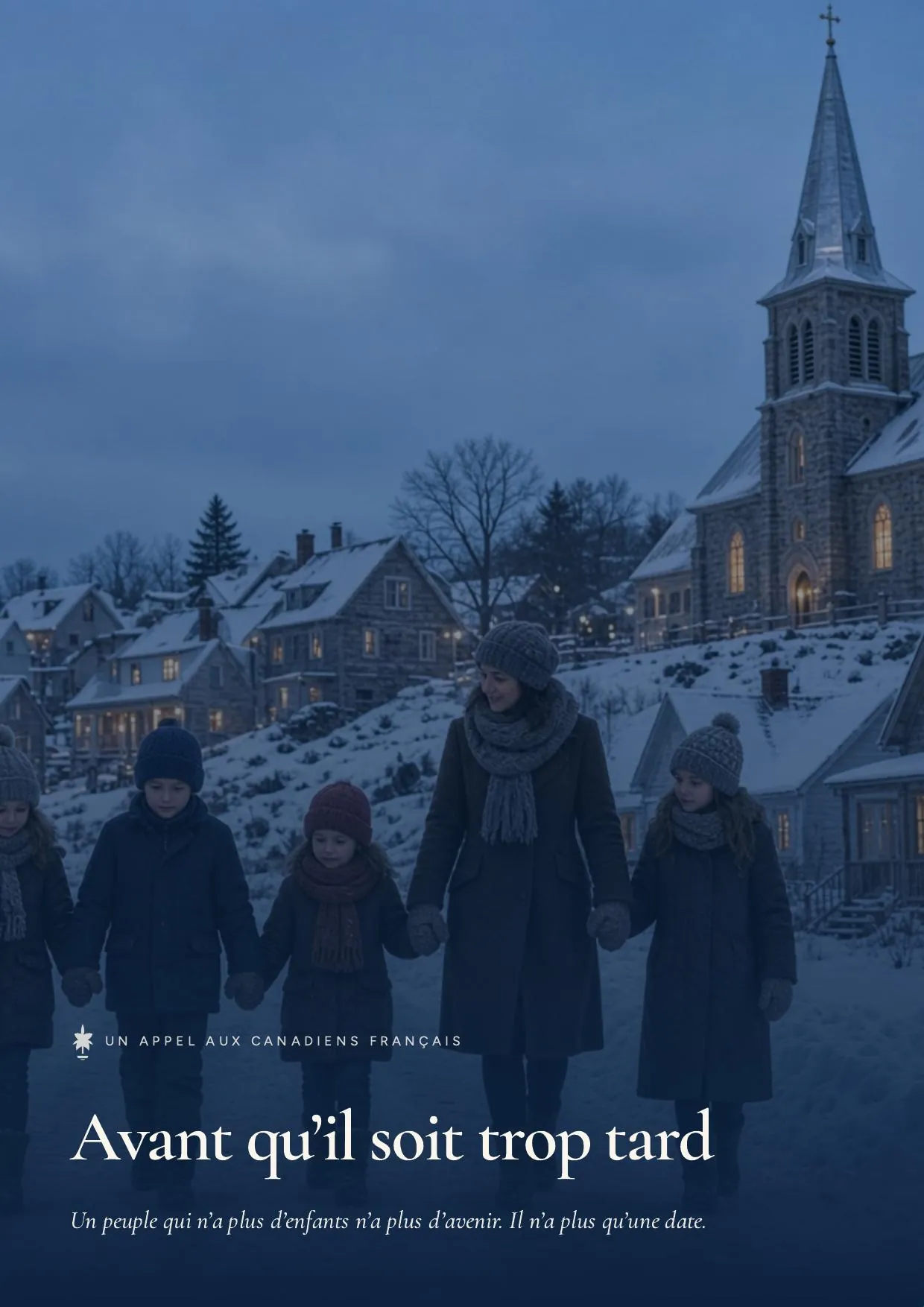
Un peuple qui n’a plus d’enfants n’a plus d’avenir. Il n’a plus qu’une date.
La lignée n’est pas seulement derrière nous. Elle se joue maintenant, dans les berceaux. Voici le bulletin — et ce qu’il faut faire, tant qu’il reste encore des Québécois.
Le creux historique
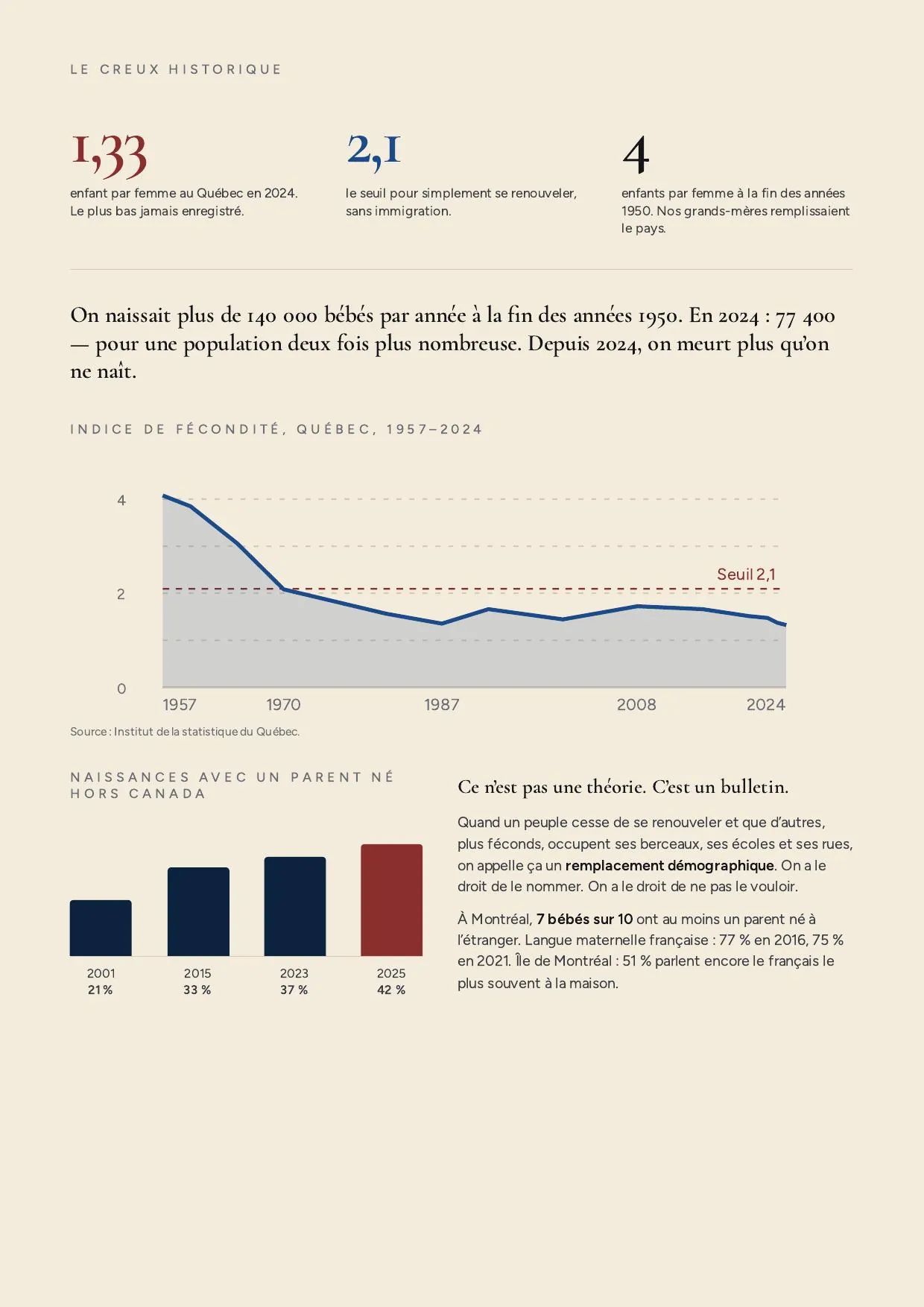
On naissait plus de 140 000 bébés par année à la fin des années 1950. En 2024 : 77 400 — pour une population deux fois plus nombreuse. Depuis 2024, le Québec perd plus de vies qu’il n’en reçoit au berceau.
1,33
enfant par femme au Québec en 2024. Le plus bas jamais enregistré.
2,1
le seuil pour simplement se renouveler, sans immigration.
4
enfants par femme à la fin des années 1950. Nos grand-mères remplissaient le pays.
Indice de fécondité, Québec, 1957–2024
Seuil 2,1
Source : Institut de la statistique du Québec. La courbe descend sous le seuil de remplacement dès les années 1970 et n’est jamais vraiment remontée.
Naissances avec un parent né hors Canada
Quand un peuple cesse de se renouveler et que d’autres, plus féconds, occupent ses berceaux, ses écoles et ses rues, on appelle ça un remplacement démographique. On a le droit de le nommer. On a le droit de ne pas le vouloir.
À Montréal, 7 bébés sur 10 ont au moins un parent né à l’étranger. Langue maternelle française : 77 % en 2016, 75 % en 2021. Île de Montréal : 51 % parlent encore le français le plus souvent à la maison.
Qui fait encore des enfants
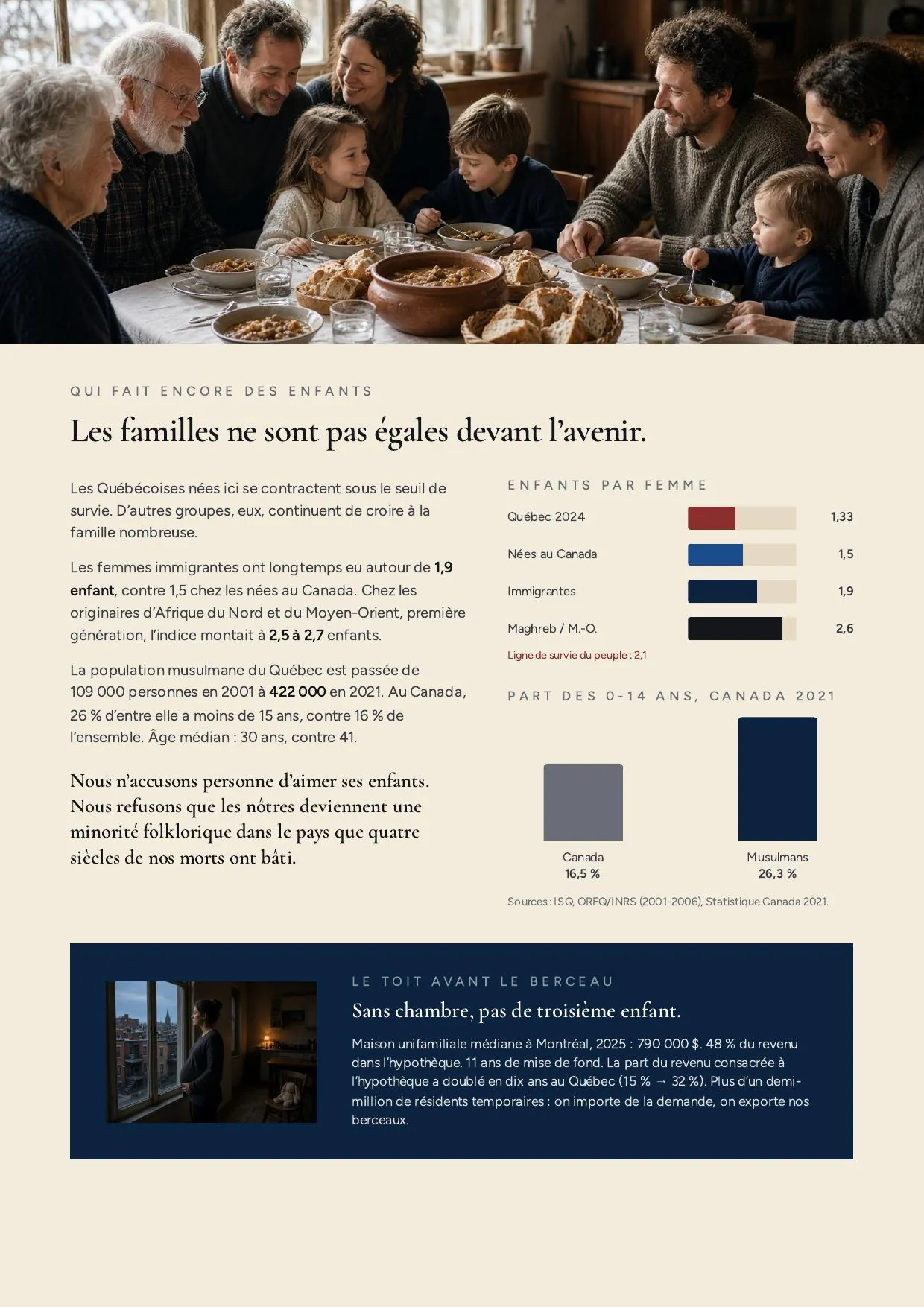
Les Québécoises nées ici se contractent sous le seuil de survie. D’autres groupes, eux, continuent de croire à la famille nombreuse. Les femmes immigrantes ont longtemps eu autour de 1,9 enfant, contre 1,5 chez les nées au Canada. Chez les originaires d’Afrique du Nord et du Moyen-Orient, première génération, l’indice montait à 2,5 à 2,7 enfants.
Enfants par femme
Ligne de survie du peuple : 2,1. Barres proportionnelles à 2,6.
Part des 0–14 ans, Canada 2021
Canada
16,5 %
Musulmans
26,3 %
La population musulmane du Québec est passée de 109 000 personnes en 2001 à 422 000 en 2021. Au Canada, 26 % d’entre elle a moins de 15 ans, contre 16 % de l’ensemble. Âge médian : 30 ans, contre 41.
Nous n’accusons personne d’aimer ses enfants. Nous refusons que les nôtres deviennent une minorité folklorique dans le pays que quatre siècles de nos morts ont bâti.
Sources : ISQ, ORFQ/INRS (2001-2006), Statistique Canada 2021.
Le toit avant le berceau
Maison unifamiliale médiane à Montréal, 2025 : 790 000 $. 48 % du revenu dans l’hypothèque. 11 ans de mise de fond. La part du revenu consacrée à l’hypothèque a doublé en dix ans au Québec (15 % → 32 %).
Plus d’un demi-million de résidents temporaires : on importe de la demande, on exporte nos berceaux.
790 000 $
maison médiane, Montréal 2025
32 %
du revenu dans l’hypothèque
31 ans
âge du premier bébé, reporté
Le droit
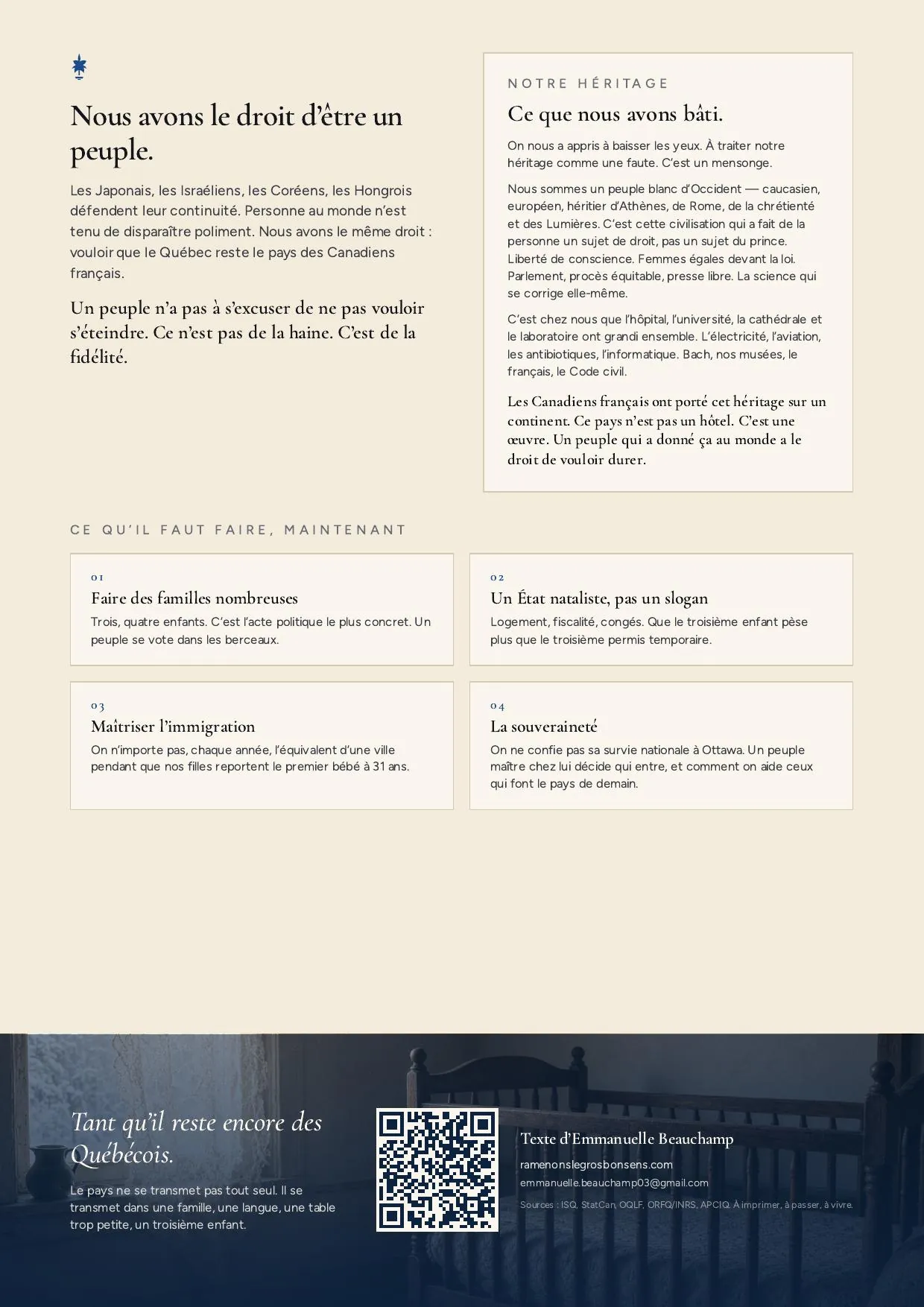
Les Japonais, les Israéliens, les Coréens, les Hongrois défendent leur continuité. Personne au monde n’est tenu de disparaître poliment. Nous avons le même droit : vouloir que le Québec reste le pays des Canadiens français.
Un peuple n’a pas à s’excuser de ne pas vouloir s’éteindre. Ce n’est pas de la haine. C’est de la fidélité.
Notre héritage — ce que nous avons bâti
On nous a appris à baisser les yeux. À traiter notre héritage comme une faute. C’est un mensonge.
Nous sommes un peuple blanc d’Occident — caucasien, européen, héritier d’Athènes, de Rome, de la chrétienté et des Lumières. C’est cette civilisation qui a fait de la personne un sujet de droit, pas un sujet du prince. Liberté de conscience. Femmes égales devant la loi. Parlement, procès équitable, presse libre. La science qui se corrige elle-même.
C’est chez nous que l’hôpital, l’université, la cathédrale et le laboratoire ont grandi ensemble. L’électricité, l’aviation, les antibiotiques, l’informatique. Bach, nos musées, le français, le Code civil.
Les Canadiens français ont porté cet héritage sur un continent. Ce pays n’est pas un hôtel. C’est une œuvre. Un peuple qui a donné ça au monde a le droit de vouloir durer.
Ce qu’il faut faire, maintenant
01
Trois, quatre enfants. C’est l’acte politique le plus concret. Un peuple se vote dans les berceaux.
02
Logement, fiscalité, congés. Que le troisième enfant pèse plus que le troisième permis temporaire.
03
On n’importe pas, chaque année, l’équivalent d’une ville pendant que nos filles reportent le premier bébé à 31 ans.
04
On ne confie pas sa survie nationale à Ottawa. Un peuple maître chez lui décide qui entre, et comment on aide ceux qui font le pays de demain.
Tant qu’il reste encore des Québécois. Le pays ne se transmet pas tout seul. Il se transmet dans une famille, une langue, une table trop petite, un troisième enfant.
À imprimer, à passer, à vivre
Le pamphlet tel quel. Même mise en page, mêmes graphiques, mêmes images. À lire ici, à télécharger, à faire circuler.
Texte d’Emmanuelle Beauchamp. Sources : ISQ, StatCan, OQLF, CRPQ/INRS, APCIQ.
The duty
You can carry the name Tremblay, sing Gens du pays, and still let in, year after year, what dissolves the people who made those names. Heritage asks for something else: borders, a language that no longer has to apologise, children who will know where they come from. Independence is not nostalgia. It is the only way not to betray the Filles du Roy — and our own.
Masters in our own house. Not tenants. Long live a free Quebec.
Sources, for those who want to check
Newsletter
When a column is published, you receive it. No ads, no address-selling.