Column · 14 September 2026
6 min read · 1 read
The Allison Inquiry: Four Days Canada Finally Let the Injured Speak
From September 8 to 11, 2026, Conservative MP Dean Allison chaired unofficial hearings on Parliament Hill for Canadians who say they were harmed by a Covid-19 vaccine. It was not a commission, not a court, and not mandated by the government. Fifty people testified under oath out of more than 1,400 who asked. This chronicle explains what the Allison Inquiry was, what was heard, and why those four days matter to someone who lived a version of the same story.

The Allison Inquiry: What It Is
From September 8 to 11, 2026, in a committee room on Parliament Hill in Ottawa, Conservative MP Dean Allison (Niagara West) chaired what is now called the Allison Inquiry.
This is not an official commission of inquiry. The federal government did not mandate it. Health Canada did not appear. The rules were clear: provide a space to hear Canadians who say they were harmed by a Covid-19 vaccine. Not to establish facts. Not to draw conclusions. At the end, committee members may put questions to Parliament. Nothing requires them to.
The hearings were held with the Covid Testimony Association, a non-profit. Constitutional lawyer Shawn Buckley served as counsel. Every MP and senator, from every party, was invited to sit. Few did.
More than 1,400 people asked to testify. Fifty were heard, under oath, over four days. Most came from across the country. Some were too sick to travel and spoke remotely. One man had to rent a medical vehicle to reach Ottawa in a wheelchair.
Canada has still not launched a parliamentary inquiry into Covid. More than thirty democratic countries have. Allison said he wanted to start “a conversation that should have started years ago.” On Friday, closing the hearings: “No matter what people think about Covid, the vaccines, or public policy, compassion should never be controversial.”
That is the Allison Inquiry. Not a court. A room, a microphone, and people who were silenced for too long.
What We Heard Over Four Days
The stories follow one another. Hearts that race or slow down. Clots. Vertigo. Fatigue that pins people to bed. Brain fog. Lost jobs. Broken families. Compensation files that vanish. Doctors who roll their eyes. Emergency rooms that look first for drugs, not the vaccine.
Drue Taylor, 36, a massage therapist in Alberta, testified remotely: her doctor judged travel too dangerous. She described a dysregulated nervous system (POTS): heart racing when she stands, nausea, exhaustion. After a year and a half of paperwork, the federal program paid her $45,000. She said that did not even replace one year of income.
Patrick Provost, a Quebec researcher, spoke of his effects after Pfizer, then of a cancer. He asked that his tissues be analyzed for Spike protein and vaccine RNA. Refused. He had to look elsewhere.
Dan Hartman opened the last day talking about his son Sean, who died at 17 after a first dose. Dr. Crystal Luchkiw testified in place of her brother Scott, a parliamentary aide, who wanted to speak and died before the hearings opened. Jamie Daniel recounted that in hospital, a psychologist offered her medical assistance in dying. She said: I was not suicidal.
We also heard U.S. Senator Ron Johnson, physicist Denis Rancourt, physician Peter McCullough, military members, healthcare workers, journalists. Each day, a list of names of the injured who were not in the room was read aloud.
Canada’s compensation program (VISP) sets the administrative scene: 3,557 claims, 1,433 reviewed by the medical committee, 252 accepted, a little more than $21 million paid out. Years of waiting. Tens of thousands of reported effects. A handful of recognitions.
The Allison Inquiry did not settle these files. It made them heard.
Technical section: the Spike, to understand what was said in Ottawa
At the inquiry, several witnesses and experts kept coming back to the same thing: the Spike protein, the “spike” of the virus that the vaccine asks our cells to manufacture.
The virus’s spike
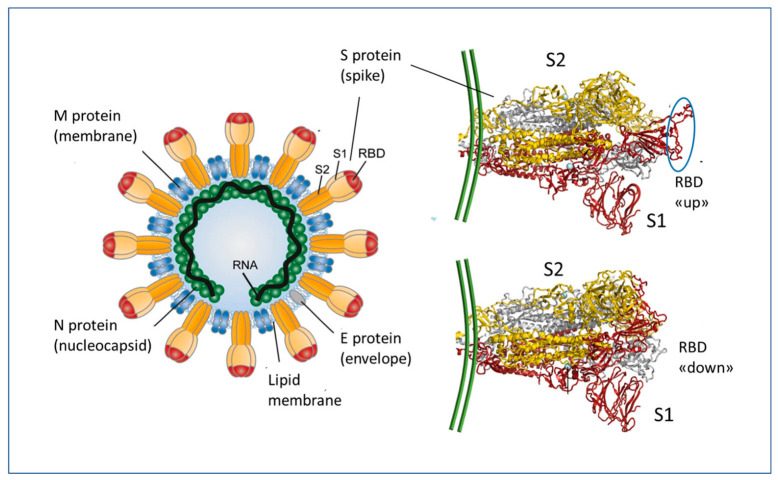
The coronavirus is covered in spikes. That is how it latches onto our cells. The mRNA vaccines (Pfizer, Moderna) do not contain the virus. They contain the instruction manual for that spike, slipped into tiny fat bubbles. The cell reads the message, makes Spikes, the immune system learns.
The virus and its Spike: the piece that opens the door to cells.
How the vaccine is supposed to work
It is injected in the shoulder. Cells produce the Spike. The body learns. In theory, the message breaks down in a few days, production stops, and only immune memory remains.
We were also told: it stays in the arm.
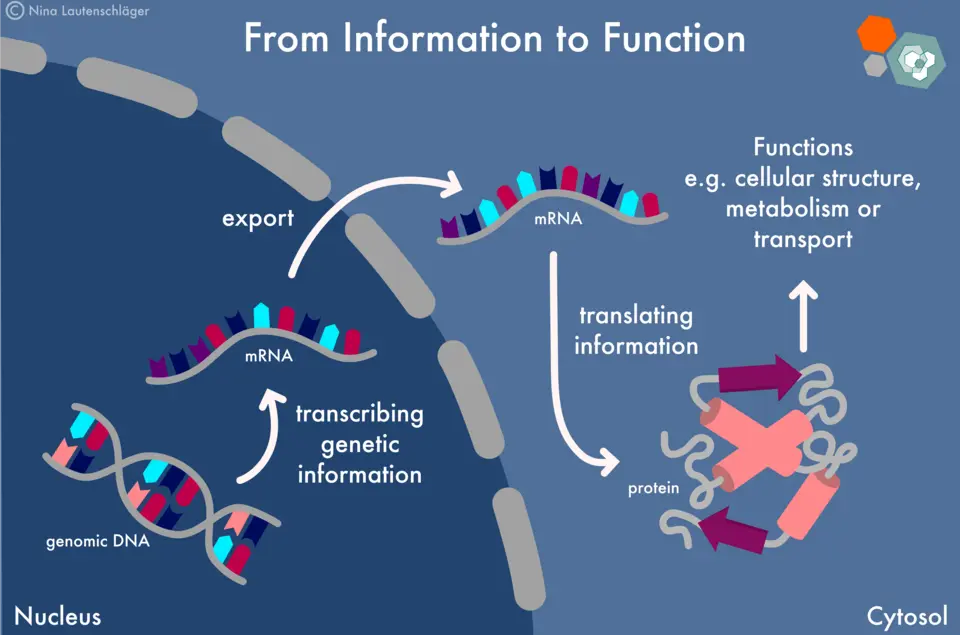
The bubble enters the cell, the cell makes Spikes, the body produces antibodies.
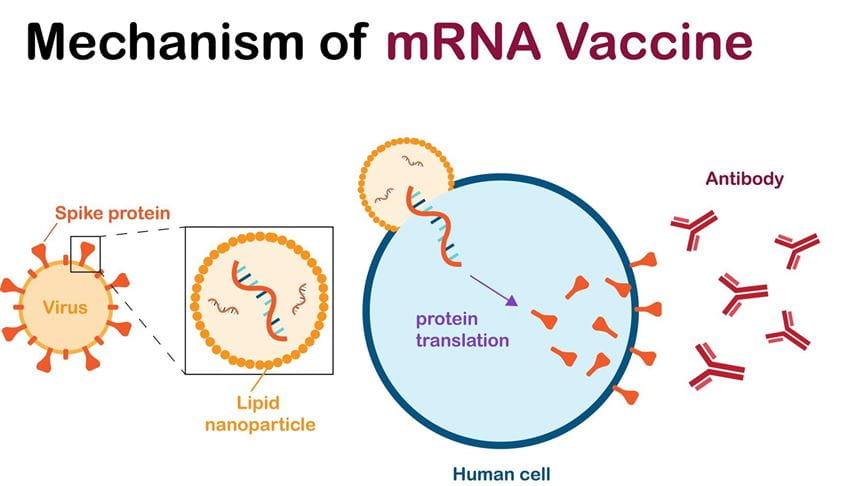
From RNA manufacturing through to the immune system’s learning.
What was observed afterward
Right after injection, researchers found Spike in the blood, not only in the muscle — as early as the next day in several people, sometimes still two weeks later.
In some people chronically ill after vaccination, a Yale team still measured Spike months, sometimes nearly two years after the last dose. The researchers themselves say: we do not know if it is the cause of the symptoms. The lead exists.
In Japan, physicians saw this protein in the wall of brain arteries, up to 17 months after vaccination, in some patients operated on for stroke. Not proof that the vaccine caused the stroke. Proof that it was too quickly said to be “impossible.”
That is the background that gives meaning to what Provost and others said in Ottawa: the product does not behave like a classic vaccine that stays quietly in the deltoid. The bubbles can circulate. The Spike can end up elsewhere. In most people, it seems short-lived. In a minority, it seems to last. Not enough has been done to ask why.
The Allison Inquiry did not have to settle this science. It showed why it at least had to be asked.
My story, and what I think of this inquiry
I was not in the room in Ottawa. But those four days, I recognized them.
After my first dose, I stayed in bed three days. Unable to get up. My heart beat very slowly. I was vomiting. I had a fever. I was constantly dizzy.
After the second dose, a week in bed. Still unable to get up. My heart beat very, very, very slowly. I was so weak that I truly thought I was going to die. There was nothing left in my body. The fever. The emptiness.
Still today: brain fog, difficulty making the slightest effort, persistent fatigue.
I was told it would pass. That it was normal. That I was lucky. No one really looked at those days when I could not get up. No one really listened to what followed.
This is my opinion of the Allison Inquiry.
It is not perfect. It is not official. It does not have the power to conclude. Some media treated it as a partisan circus. Others, at last, began to report the tears in the room.
I see something else. I see the only space where an injured Canadian could speak in front of elected officials without being immediately filed under “anti-vax.” I see 1,400 files for 50 microphones. I see a father talking about his 17-year-old son. I see a sister speaking in place of a brother already dead. I see a compensation program that recognized 252 people out of thousands of claims.
I am not asking anyone to believe me for the whole planet. I am asking that we stop acting as if people like me, and like the fifty in Ottawa, do not exist.
To describe my heart beating too slowly, my vomiting, a week pinned to the bed and a fatigue that lasts is not an insult to science. It is describing a body. The Allison Inquiry did exactly that: describe bodies, one by one, for four days.
Four days is not a national inquiry. It is already more than the government agreed to do.
It was time to listen. It is still time not to close the door.