Column · 26 September 2026
5 min read · 1 read
“We will rule CANADA”: the Bishnoi gang, Ottawa’s open door, and a country that no longer controls who comes in
A gang run from an Indian prison wrote to Canadian police: we will rule this country, we have thousands of men, every business will pay a “tax.” Behind the swagger is a documented machine of extortion and intimidation and a federal immigration system that let the foot soldiers walk in on study and work permits. Quebec does not run that system. That is the point.
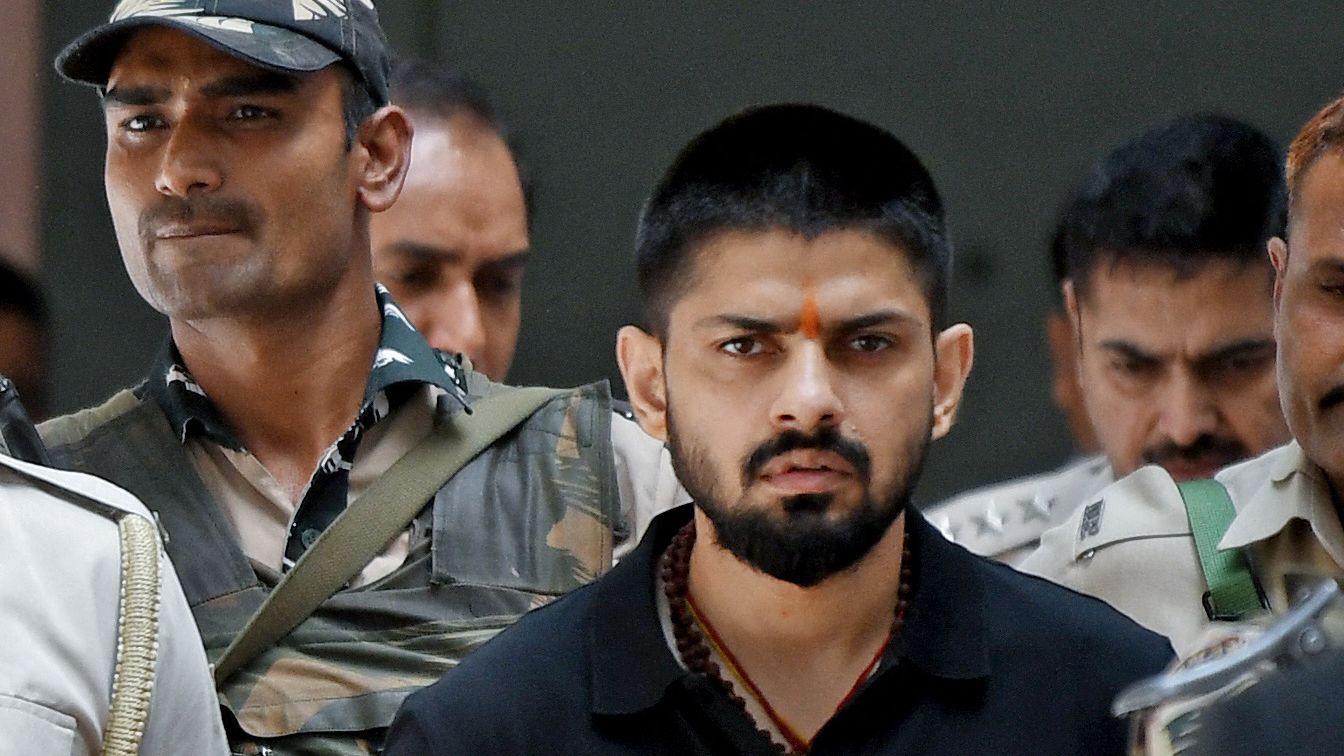
Lawrence Bishnoi does not need to set foot here. He issues orders from jail. The face below is the one the world’s press uses: escorted, not free and still, according to Canadian and U.S. investigators, operational.
In August 2025, a letter signed “Lawrence gang from India” was delivered to the Abbotsford Police Department and addressed to Canada’s “defence minister, army and police.” CBC later obtained the full text. It is barely literate. It is not ambiguous. “Canada has no guts to stop us… we will rule in CANADA now… You will see we will takeover CANADA soon.” The writers claim more than 5,000 members in Canada, shootings for $1,000, more guns than the police, and a protection racket that every business — “Indian or white or black” — will have to pay “like TAX.”
Ottawa listed the Bishnoi gang as a terrorist entity in September 2025. That listing came after the network was already recruiting, shooting and burning.
Watch: CBC on the letter — YouTube Watch: seized phone videos (guns, cash, arson) — YouTube · CBC player
Who they are
Lawrence Bishnoi (born Balkaran Brar, 1993) is a former Indian campus politician turned crime boss. He has been in custody in India since 2015. Investigators say he still runs a transnational network by smuggled phones: extortion, contract shootings, arson, drug trafficking, and in U.S. indictments a role in the 2023 killing of Sikh activist Hardeep Singh Nijjar outside a Surrey temple. Bishnoi denies the allegations.
The Canadian footprint is not a rumour. It is in RCMP files, CBSA “tactical guides,” immigration hearings and FBI charging documents. The main theatres have been British Columbia, Ontario and Alberta. The method is cheap terror: WhatsApp threats, a burst of gunfire into a house or shop, then a demand for money.
“Shooting for $1,000” does not mean the damage costs a thousand dollars. It means the hired shooter is paid about $1,000 to fire at a target often a young Indian national already in Canada so the victim understands the next round may not be aimed at the wall.
CBC’s cache of hearing exhibits is uglier still: alleged associates posing with pistols and shotguns, pointing a gun at a friend’s head at a birthday party, firing a distinctive pink-slide handgun into the air (casings later tied to shootings in Surrey), filming a burning house, flashing cash and ammunition. One man, Sahibjot Singh, was removed from Canada after such videos surfaced on his phone. He denied being Bishnoi. The paper trail put him in the same Edmonton cluster as other suspects.
They did not swim the border. They used the forms.
A large share of the “foot soldiers” did not sneak in. They arrived on study permits and temporary work permits. Goldy Brar, repeatedly described as a North American lieutenant, entered in 2017 on a student permit. FINTRAC and CBSA assessments describe the same pattern: financially vulnerable young Indian men already in the country, used as contractors, money mules and shooters.
CBSA has opened hundreds of immigration investigations tied to this network, issued well over a hundred removal orders and carried out dozens of deportations. That is not proof the system works. It is proof the filter failed first, and enforcement is chasing the damage.
Quebec is not the main stage of this particular wave. That is not comfort. Visas, temporary status and most of the border machinery are federal. A gang that boasts it will “takeover CANADA” is not going to stop at the Ottawa River out of courtesy.
The taboo that kept the story late
For years, naming the source country, the visa class and the recruiting pool was treated as a moral offence. Officials spoke of “communities” and a “climate of fear” while avoiding the mechanism: mass temporary migration with weak screening, weak follow-up and slow removal. The public learned the scale from a gangster’s letter, not from a ministry briefing.
It is not “hate” to notice that an Indian crime syndicate used Canadian study and work streams as a staffing office. It is a description of what police, border officers and prosecutors have put on the record. A state that is afraid of its own facts is not compassionate. It is disarmed.
Ottawa’s terrorist listing gives police extra tools. It does not undo the years in which the country imported the labour force of a foreign gang and then acted surprised when the labour force started working. Federalism, on this file, means one national policy designed in Ottawa, applied everywhere, and owned by no one when it blows up.
A Quebec that actually controlled selection, status and removals on its territory would not have to wait for the House of Commons to decide how much candour is allowed. It would decide who enters, for how long, and who leaves.
What the letter actually proves
Treat the “5,000 members” figure as a boast. Earlier police accounts spoke of a thousand-plus willing shooters; the letter inflates the number the way rackets always do. The intent is the story: they judged Canada too timid to stop them, and they said so in writing.
A country that lets a jailed foreign boss assemble an extortion militia on student visas does not have an “integration challenge.” It has a sovereignty problem.
Quebecers who still think of themselves as a people language, territory, the right to choose who joins them cannot file this under “a Surrey problem” or “a Brampton problem.” Same regime. Same rules. Same refusal to connect volume, origin and imported organised crime.
Immigration is not the issue in the abstract. An immigration system that cannot say no and a political culture that treats saying no as a sin is. The Bishnoi letter is not an outlier. It is a receipt.
The answer is not another press release about diversity. It is control: fewer disposable permits, real vetting, fast removals and, for Quebec, the powers of a state that no longer has to beg Ottawa to shut the tap after the floor is already underwater.
They put it in writing. The only remaining question is whether anyone here is still allowed to read it out loud.