Column · 2 October 2026
4 min read · 1 read
France: high-school protests hit 1,027 schools, Nelson Mandela lycée hall set on fire in Nantes
On 28 September, in Saint-Denis, teachers linked arms outside the Lycée Paul-Éluard to stand between pupils and the police. On 1 October the movement reached **1,027 lycées**, including **222 blockades**, and police arrested **1,949 people**. The same day, in Nantes, the hall of the Lycée Nelson Mandela, opened in 2014, went up in flames. One movement, two images. One of them is the story. The other is what actually burned
On Thursday 1 October, the hall of the Lycée Nelson Mandela in Nantes burned. Opened in 2014, a positive-energy building, winner of the national wood-construction prize. A new school, not a ruin of the Third Republic. The fire started in bins during a blockade, spread into the hall, and reached the cafeteria and boarding rooms. The deputy head called it a deliberate fire. The school will not reopen before the Toussaint holidays. Pupils on the spot summed it up the way it is said in those playgrounds: “Wesh, it burned.”
This was not an isolated accident. Since 17 September the movement had started at the Lycée Saint-Exupéry in Créteil, the day after a teachers’ strike. It then spread through the 93, Aubervilliers, Saint-Denis, then Lille, Lyon, Rennes, Toulouse, Marseille and Nantes. On Thursday the Interior Ministry counted 1,027 schools affected, including 222 blockades, 1,949 arrests, and 84 police officers or gendarmes injured. Le Figaro reported 1,793 people in custody that evening, 90 percent of them minors. On the education side, Édouard Geffray spoke of 235 injured since Monday, including 170 pupils and 65 staff. In Marseille, teachers were splashed with petrol. In Strasbourg, a tram line was stopped to “restrict the movements of rioters.” The Bobigny prosecutor described a pre-riot situation. Geffray eventually used the useful phrase: the movement had been “taken hostage by ultra-violent groups.”
The stated demands are familiar: teachers not replaced, classes of 35, decaying buildings, Parcoursup. Part of that is real. At the start of term at least one teacher was missing in 53 percent of public middle and high schools, according to the Snes-FSU, and about 7.5 percent of secondary teaching hours go uncovered. That is not what sets fire to a school built in 2014. You do not demand working toilets by burning the entrance hall and dousing teachers in petrol.
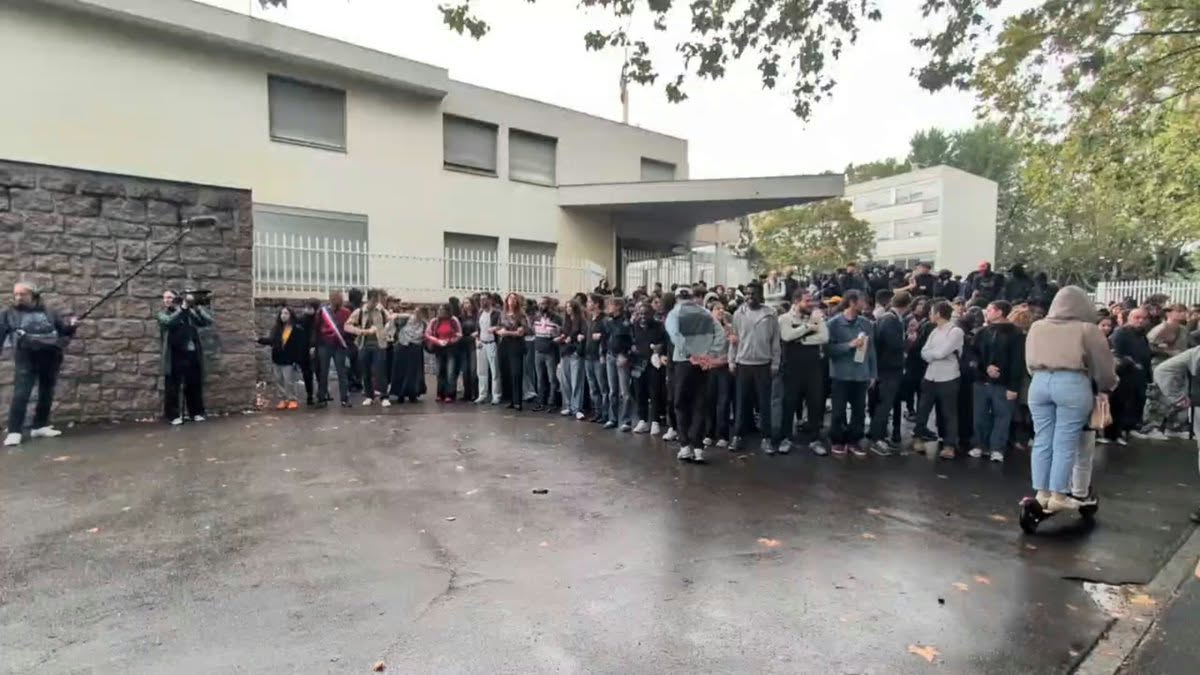
And while the building burned, another image was circulating, carefully chosen by the left. In Saint-Denis, outside the Lycée Paul-Éluard on 28 September, then outside the Lycée Suger on 1 October, teachers and education assistants formed a human chain between the protesting pupils and the police. The same scene was copied at the Lycée des Arènes in Toulouse. The activist account was ready: teachers protecting children from the police. Watch the sequence to the end. Fireworks mortars were aimed at officers. The LFI mayor of Saint-Denis, Bally Bagayoko, had been on site in the preceding days and told BFM that “violence, at a certain point, can be legitimate.” The police prefect referred him to prosecutors for incitement to commit an offence. The human chain does not separate well-behaved children from a mad police force. It stands between public order and a riot that far-left elected officials have come to legitimise.
What the images show has to be said, because the talk shows will not name it. The core of the movement is not the city-centre lycée where people revise for the French baccalauréat. It is Créteil, Saint-Denis, Aubervilliers, Seine-Saint-Denis, the suburban schools where the France of before has already disappeared from the playground. On the videos of blockades that turn violent, the faces, the first names, the language are not those of a “diverse” youth in the sense of the Education Ministry brochures. They are, in very large majority, young Arab Muslims and young Black people, born here or arrived through the migration chain, in schools that forty years of mass immigration have transformed. The state will not publish the statistic: it has forbidden it. The videos get through. And it is these same neighbourhoods that supply, at every flare-up, the same scenes: bins on fire, mortars, stoned buses, a school hall burned out.
La France insoumise denies organising anything. The intelligence services, at Thursday’s crisis meeting at Beauvau, said the opposite: an operation mounted by LFI and its relays. Louis Boyard denies it. The exact degree of instruction hardly matters. The result is there. A far left that no longer wins the middle classes goes looking for its troops where the school has already given way, tells them the police are the enemy, and calls it a lycée mobilisation. The media talk of “angry youth” and “police violence.” They do not talk about the new hall that is burning, or about who is holding the mortar.
More than 400 schools stay closed this Friday. Protests banned outside the closed lycées. Classes online. Sébastien Lecornu held a crisis meeting the same day he presented a budget. The Union syndicale lycéenne promises a next act on 6 October. The sequel is known if no one names what is in front of them: another school in ashes, another human chain for the cameras, and columnists explaining that it is the fault of funding, the climate, Parcoursup — of everything except what can be seen.